
The New Engineering Contract (NEC4) Explained: What UK Contractors Need to Know in 2026
The New Engineering Contract (NEC) is a family of collaborative construction and engineering contracts used across UK infrastructure and public sector projects. Its current edition, NEC4, uses early warnings, compensation events, and a live accepted programme to manage cost, time, and risk proactively — not retrospectively.
On This Page
- What Is The New Engineering Contract?
- What Are the 9 Core Clauses of the NEC?
- NEC3 vs NEC4: What Changed?
- NEC vs JCT: What Is the Difference?
- How Do NEC Contractors Manage Construction Contracts?
- What Are the NEC4 Main Options A–F?
- What Are the Most Important NEC4 Terms to Know?
- What Is the NEC Professional Services Contract?
- How Does Contract Administration Work in Construction?
- How Do You Manage a Compensation Event Under NEC4?
- What Are the Most Common NEC Contract Mistakes?
- Tender Documents and Consultancy Agreements
- When Should You Hire an NEC Quantity Surveyor?
- Frequently Asked Questions
The New Engineering Contract now governs some of the UK’s largest projects, from HS2 to Thames Tideway. Yet many teams still misprice risk and notify changes too late. That single gap drains budgets and stalls programmes.
You have probably felt the pressure. Vague scopes, late variations, and disputed payments all erode margins. Contractors, engineers, and property owners lose weeks arguing over clauses nobody defined clearly at tender.
At Quentessential Surveying, our quantity surveyors support contractors and employers with NEC contract administration, compensation events, tender documentation, and commercial management across UK construction projects. In this article, you will learn how NEC contracts work, how to administer them well, and when to bring in expert support — without expensive surprises later.
Last reviewed: July 2026.
Key Takeaways
- The New Engineering Contract is the UK’s leading collaborative construction contract, now in its fourth edition (NEC4).
- The Institution of Civil Engineers publishes it. The Government Construction Board (Cabinet Office) recommends it — particularly NEC4 — for public sector construction.
- Early warnings and compensation events replace many traditional variation and claim processes.
- The accepted programme is a live, contractual document — not an afterthought.
- Poor contract administration is a leading cause of disputes, so expert commercial support pays for itself.
Quick Definitions
| Term | Meaning |
|---|---|
| NEC | New Engineering Contract |
| ECC | Engineering and Construction Contract |
| PSC | Professional Services Contract |
| CE | Compensation Event |
| PM | Project Manager |
What Is The New Engineering Contract?
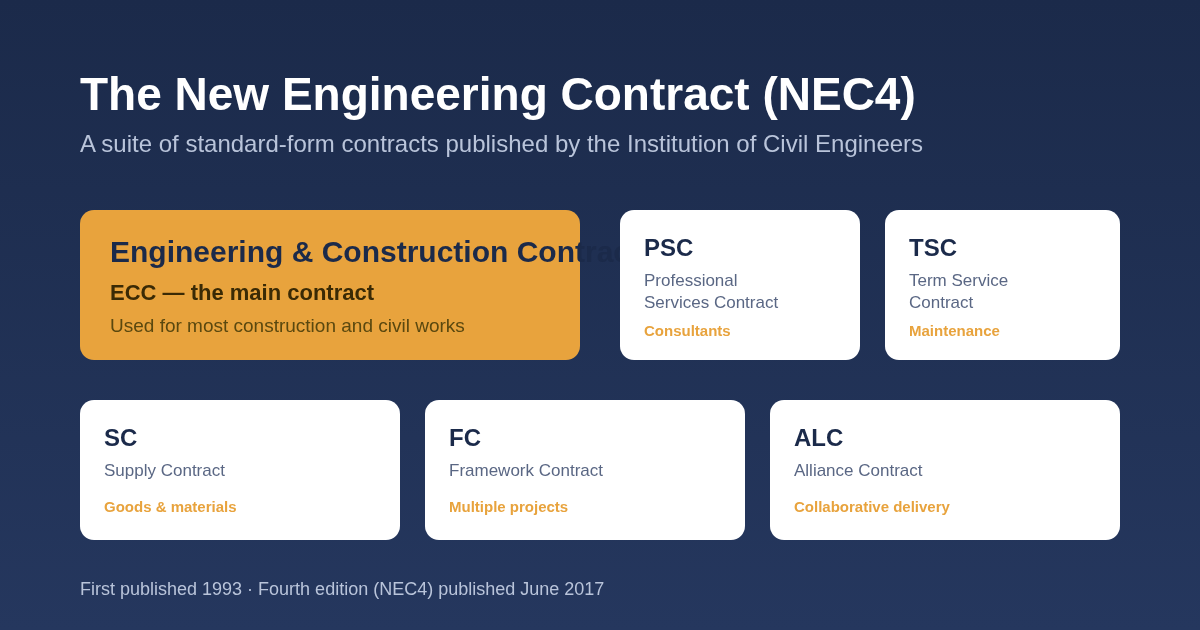
The New Engineering Contract is a suite of standard-form construction and engineering contracts published by the Institution of Civil Engineers. It works by defining roles, risk, and payment through clear, present-tense clauses. Most commonly used for infrastructure, building, and public sector projects across the UK.
Understanding the basics matters because NEC contracts dominate UK public procurement. Knowing the structure helps you tender and deliver with confidence.
The suite first appeared in 1993 and reached its fourth edition, NEC4, in June 2017. The Engineering and Construction Contract (ECC) is the main form most people mean by “an NEC contract” [Institution of Civil Engineers, NEC, 2017]. It is used across highways, rail, water, utilities, and public building work by clients such as National Highways, Network Rail, and the Environment Agency.
Need help selecting or administering the right form? Our quantity surveying services support contractors and employers from tender to final account.
What Are the 9 Core Clauses of the NEC?
Every NEC contract is built on the same nine core clause sections. Knowing them helps you find the right rule fast. This structure is identical across the suite.
The nine NEC core clauses are the fixed sections that appear in every contract. They work as the shared backbone beneath your chosen options. They cover: General; Contractor’s responsibilities; Time; Quality Management; Payment; Compensation Events; Title; Liabilities and Insurance; and Termination.
You then bolt on one main option (A to F) and any secondary options. This modular “shell” structure is what makes NEC flexible across so many project types.
NEC3 vs NEC4: What Changed?
Many live projects still run on NEC3, so contractors need to know both. NEC4 kept the same collaborative core but refined the detail. Understanding the shift helps you administer either edition correctly.
NEC3 and NEC4 are consecutive editions of the same contract suite. NEC4 works by building on NEC3, not replacing it. It adds new contract types, clearer processes, and stronger collaboration tools.
Key changes NEC4 introduced over NEC3:
- New contract types, including the Design Build Operate (DBO) and Alliance Contract (ALC).
- A formal dividing date and clearer treatment of Defined Cost.
- Quotations for proposed instructions, so parties can price a change before it is ordered.
- Contractor’s and Client’s terminology, replacing NEC3’s “Employer” with “Client” for plainer language.
- A finalisation of accounts process to close out the final payment more cleanly.
NEC3 remains valid and widely used, especially on long frameworks. NEC4 is the current edition and the default choice for new UK projects.
NEC vs JCT: What Is the Difference?
Contractors search this comparison constantly before choosing a form. The two families take very different approaches to risk and collaboration. Picking the wrong one can expose you to avoidable cost.
NEC and JCT are the two main UK construction contract families. NEC works by promoting collaboration, early warnings, and a live programme. JCT follows a more traditional, lump-sum approach. NEC suits infrastructure and public works; JCT suits many private building projects.
| Feature | NEC4 | JCT |
|---|---|---|
| Ethos | Collaborative, proactive | Traditional, more adversarial |
| Change control | Compensation events (assessed as they arise) | Variations plus loss and expense (often retrospective) |
| Early warning | Mandatory early warning system | No direct equivalent |
| Programme | Accepted programme is contractual | Programme rarely a core contract document |
| Language | Plain English, present tense | Traditional legal drafting |
| Common use | Infrastructure, public sector | Building, private sector |
Both are valid. The right choice depends on your project, client, and risk appetite. Our commercial management services can advise before you commit.
How Do NEC Contractors Manage Construction Contracts?
NEC contractors work differently from teams using traditional forms. The contract rewards proactive management, early warnings, and shared programmes. This collaborative approach reduces disputes on complex construction contracts.
NEC contractors are firms delivering works under a New Engineering Contract in the UK. They manage construction contracts by issuing early warnings, agreeing compensation events, and keeping a live accepted programme. Most commonly used on public and private infrastructure projects.
NEC contractors UK-wide use main Options A to F to split cost risk. Option A fixes price with an activity schedule. Option C shares risk through a target cost with pain-and-gain sharing. Option F is a management contract.
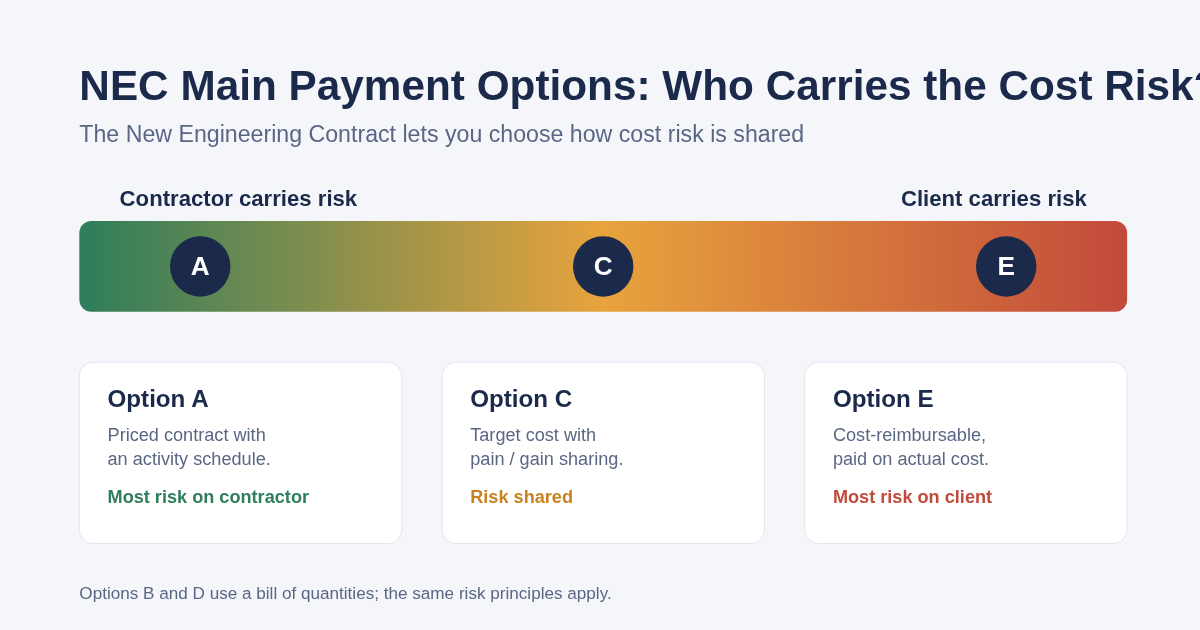 NEC payment options: how cost risk shifts from contractor to client across Options A, C and E.
In our experience, many contractors notify compensation events correctly but neglect the accepted programme. That weakens entitlement the moment a delay arises, because the programme is your primary evidence.
What Are the NEC4 Main Options A–F?
The main option you choose decides who carries the cost risk. It is the single most important commercial decision in an NEC contract. Get it right and pricing, payment, and risk all align with the project.
The NEC4 main options (A to F) set the pricing and risk model for the contract. They work by pairing a payment mechanism with a cost-risk allocation. They range from a fixed price (A) to fully cost-reimbursable (E) and a management contract (F).
| Option | Contract type | Payment basis | Main cost risk |
|---|---|---|---|
| A | Priced contract | Activity schedule | Contractor |
| B | Priced contract | Bill of quantities | Contractor |
| C | Target contract | Activity schedule | Shared |
| D | Target contract | Bill of quantities | Shared |
| E | Cost reimbursable | Defined Cost | Client |
| F | Management contract | Management basis | Client |
Option A: Priced Contract with Activity Schedule
The contractor prices a list of activities. It carries most of the cost risk, which suits well-defined scopes.
Option B: Priced Contract with Bill of Quantities
Similar to Option A, but priced against a bill of quantities. It works where a measured approach fits the works.
Option C: Target Contract with Activity Schedule
The parties agree a target cost and share pain and gain. This aligns incentives on more uncertain projects.
Option D: Target Contract with Bill of Quantities
A target-cost model priced against a bill of quantities. It blends measurement with shared risk.
Option E: Cost Reimbursable Contract
The client pays Defined Cost plus fee. It suits urgent or poorly defined work where scope is still evolving.
Option F: Management Contract
The contractor manages subcontractors for a fee. The client carries most of the delivery cost risk.
Unsure which option fits your project? Our commercial management services help you weigh risk against certainty before you commit.
What Are the Most Important NEC4 Terms to Know?
Most NEC disputes trace back to a handful of misunderstood terms. Clear definitions help contractors, subcontractors, and clients act on time. These are also the questions people ask search engines most.
What Is a Compensation Event?
A compensation event is an event under NEC that entitles the contractor to more time or money. It works through a set notification and quotation process. Most commonly used to handle changes, delays, and client-side risks.
What Is an Early Warning Notice?
An early warning notice flags a matter that could affect cost, time, or quality. It works by prompting an early risk-reduction discussion. Most commonly used before a problem becomes a formal claim.
What Is the Accepted Programme?
The accepted programme is the contractor’s approved plan for delivering the works. It works as the live baseline for assessing delay and change. Most commonly used to keep compensation events evidence-based.
What Is Contract Data?
Contract Data is the project-specific information that completes an NEC contract. It works in two parts: the client’s data (Part One) and the contractor’s data (Part Two). Most commonly used to set key dates, options, and payment terms.
📌 Halfway recap. The New Engineering Contract runs on three habits: raise early warnings fast, handle changes as compensation events, and keep the accepted programme live. Get those right and most disputes never start. Need a hand? Talk to our quantity surveyors.
What Is the NEC Professional Services Contract?
Consultants need the right appointment form, not just contractors. The NEC Professional Services Contract keeps the whole delivery team on one set of rules. This consistency protects clients when problems arise mid-project.
The NEC Professional Services Contract (PSC) appoints consultants who provide professional services on a project. It works by applying the same collaborative NEC principles used for contractors. Most commonly used for project managers, engineers, architects, designers, and quantity surveyors.
The PSC offers three payment options: lump sum, target cost, or time-based. Under target and time-based options, consultants recover the real cost of their staff [Bryan Cave Leighton Paisner, BCLP, 2023].
How Does Contract Administration Work in Construction?
Contract administration decides whether a project stays on budget. Poor administration turns small issues into formal disputes. Strong administration keeps records tight and payments defensible.
Contract administration in construction is the day-to-day management of a contract after signing. It works by tracking programmes, valuing work, assessing changes, and certifying payment on time. Most commonly used to control cost, quality, and risk across the project lifecycle.
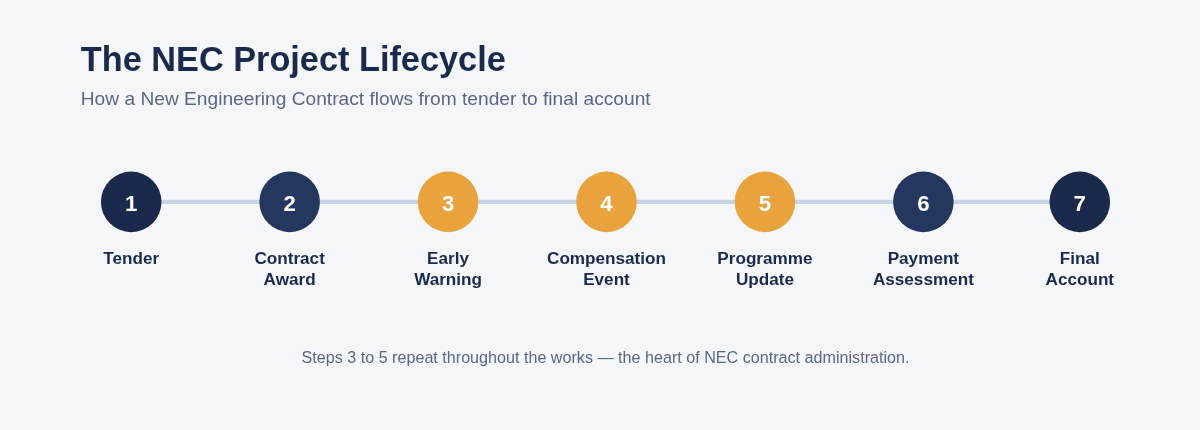 The NEC project lifecycle: early warnings, compensation events and programme updates repeat throughout the works.
The stakes are high. The average construction dispute on major projects now exceeds £27 million, taking over 14 months to resolve [Arcadis Global Construction Disputes Report, Arcadis, 2024]. The same research repeatedly names failure to administer the contract properly as a leading cause. Strong NEC contract administration is your cheapest insurance against that.
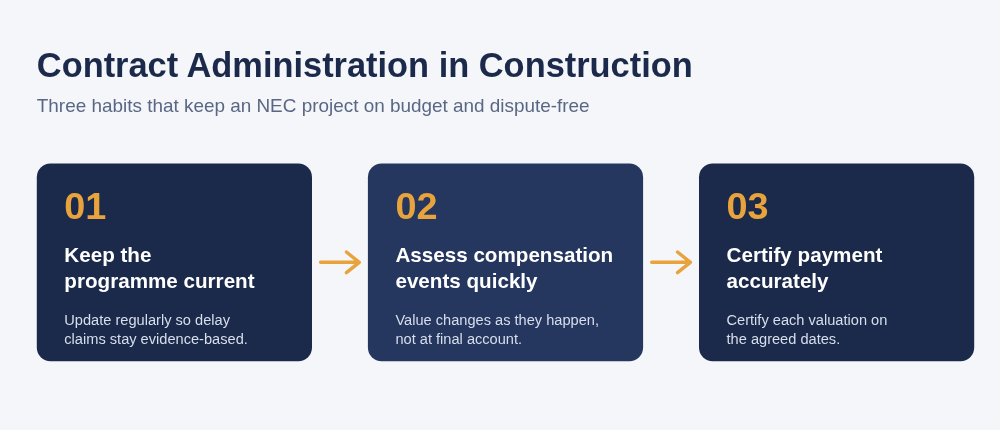
Keep the Accepted Programme Current
Update the programme regularly so delay claims stay evidence-based. A live programme protects both client and contractor.
Assess Compensation Events Quickly
Value changes as they happen, not at final account. Late assessment inflates cost and fuels disagreement.
Certify Payment Accurately
Certify each interim valuation on the agreed dates. Accurate certification avoids interest, disputes, and cash-flow damage.
How Do You Manage a Compensation Event Under NEC4?
Compensation events are where most NEC time and money is won or lost. A clear, repeatable process protects your entitlement. Follow these steps every time one arises.
Managing a compensation event means following NEC’s set notification and quotation process. First, you confirm the event qualifies. Then you notify it in time, price its effect, and agree the impact. Done promptly, it keeps cost and programme under control and avoids disputes.
- Identify whether the event qualifies as a compensation event under the contract.
- Notify the event within the contractual time limit.
- Assess its effect on Defined Cost and the accepted programme.
- Prepare and submit your quotation.
- Review the Project Manager’s response.
- Update the accepted programme where required.
- Record the agreed time and cost impact.
Need support building this into your workflow? Our commercial management services can help.
What Are the Most Common NEC Contract Mistakes?
Even experienced teams repeat the same avoidable errors. Each one quietly weakens your commercial position. Spotting them early protects both time and margin.
The most common NEC mistakes involve late notices and weak records. They work against you by breaching strict time-bars and losing entitlement. Most commonly seen in early warnings, compensation events, and payment applications.
A frequent one: contractors treat compensation events like end-of-project variations. Under NEC, that timing gap often creates avoidable payment disputes. Watch for these:
- Late early warnings that reduce your risk-reduction options.
- Poor programmes that make delay claims hard to prove.
- Missed compensation event time-bars that forfeit entitlement.
- Incorrect payment applications that trigger cash-flow problems.
- Weak records that undermine any later claim.
Avoiding these is exactly where our dispute resolution services add value.
Which Tender Documents and Consultancy Agreements Do You Need?
Good outcomes start before signing, at the tender stage. Clear tender documents remove ambiguity that later causes conflict. A well-drafted consultancy agreement protects your professional position too.
Tender documents are the papers issued to bidders so they can price a project accurately. They work by defining scope, drawings, conditions, and pricing rules in one place. Most commonly used to compare bids fairly and award a defensible contract.
Strong tender documentation should include the scope, the Contract Data, and a pricing schedule. A consultancy agreement — or contract for services — then sets fees, duties, and liability for your appointed advisers. Our estimating and tendering services prepare documentation that stands up under NEC.
When Should You Hire an NEC Quantity Surveyor?
Not every project needs full-time commercial support. But NEC’s strict processes reward specialist input at the right moments. Knowing when to call helps you avoid costly gaps.
You should hire an NEC quantity surveyor when cost, change, or risk becomes hard to control. They work by managing valuations, compensation events, and programmes. Most commonly used on infrastructure, renewables, commercial, and public sector schemes.
Bring in an NEC quantity surveyor when you face frequent compensation events, disputed payment notices, complex programmes, or a live tender. Early involvement usually costs far less than late dispute resolution.
In our experience, the projects that stay profitable are the ones that treat contract administration as a weekly habit, not a final-account scramble. Small, timely notices beat large, contested claims every time.
Why Choose an Engineering Procurement Contract Like The New Engineering Contract?
Choosing the right form shapes your whole delivery strategy. An engineering procurement contract sets how you buy design, works, and services. The New Engineering Contract gives you flexibility across all three.
An engineering procurement contract governs how a client buys engineering design, works, or services. It works by allocating scope, risk, and payment between the parties. Most commonly used on infrastructure and complex construction where clarity reduces disputes.
The New Engineering Contract now ranks among the most widely used standard forms in the UK. HS2 is described as the world’s largest NEC-procured project to date, worth around £45 billion on its first phase [Institution of Civil Engineers, NEC, 2022]. Its clear language and shared programme make risk visible early.
Frequently Asked Questions
What does NEC stand for?
NEC stands for the New Engineering Contract, a suite of standard-form UK construction and engineering contracts.
Who uses NEC contracts?
Public and private clients, contractors, subcontractors, and consultants — especially on infrastructure, rail, water, and public building work.
What are the advantages of NEC contracts?
Clear language, collaborative working, early warnings, a live programme, and prompt change management that reduces disputes.
When did NEC4 replace NEC3?
NEC4 was published in June 2017. It updated NEC3 rather than replacing it overnight.
Are NEC3 contracts still used?
Yes. Many long-term frameworks awarded under NEC3 remain live, so NEC3 will run for years yet.
What is a NEC3 contract?
The third edition of the NEC suite, published in 2005 and revised in 2013, still used on legacy projects.
Is NEC4 mandatory in the UK?
Not strictly. The Government Construction Board recommends NEC — particularly NEC4 — for public sector construction, and some frameworks require it. Private clients may choose it freely.
What is the risk in a NEC contract?
Cost risk sits mainly with the contractor under Option A and mainly with the client under Option E, with Option C sharing it.
Is NEC better than JCT?
Neither is universally better. NEC suits collaborative infrastructure work; JCT suits many traditional building projects.
What is the difference between NEC and FIDIC?
NEC is UK-origin and collaborative. FIDIC is an international suite used worldwide, with a more traditional, engineer-administered risk approach.
When would you use a JCT contract?
Typically on private-sector building projects where a traditional, lump-sum approach suits the client and design is well advanced.
Can subcontractors use NEC?
Yes. The NEC suite includes subcontract forms that mirror the main contract terms.
Does NEC reduce disputes?
It is designed to. Early warnings and prompt compensation events help resolve issues before they escalate.
Do I need a quantity surveyor for NEC projects?
Not always, but one is highly valuable where compensation events, valuations, and programmes become complex or contested.
Can Quentessential Surveying review our NEC contract?
Yes. We review NEC contracts and Contract Data, and support tendering, administration, and dispute avoidance. Get in touch.
Can you help with compensation events?
Yes. We prepare, assess, and negotiate compensation events to protect your time and cost entitlement.
Do you support subcontractors?
Yes. We support contractors, subcontractors, and employers across the UK construction sector.
Conclusion
Overall, the New Engineering Contract gives UK teams a clear, collaborative way to manage cost and risk. Its clause structure and shared programme make problems visible early, before they turn into disputes. NEC contractors deliver best when early warnings, live programmes, and accurate certification stay in place throughout the works.
The consultant side matters just as much. The NEC Professional Services Contract keeps engineers, architects, and quantity surveyors on the same collaborative rules as the main contractor. That consistency protects clients when scope, cost, or time comes under pressure.
Ultimately, strong tender documents and a solid consultancy agreement remove the ambiguity that fuels most conflict. Choosing the right engineering procurement contract then sets how you buy design, works, and services with confidence. Get these fundamentals right and The New Engineering Contract rewards you with fewer disputes, tighter budgets, and projects that finish on time.
Managing an NEC Project? Talk to Our Quantity Surveyors
Our quantity surveyors support contractors and employers with NEC contract administration, compensation events, tender documentation, commercial management, and dispute avoidance across the UK. Whether you are pricing a tender, managing compensation events, or reviewing Contract Data, we help you reduce commercial risk and keep your project under The New Engineering Contract on track.
Speak to the Quentessential Surveying team today →
Related Articles
Explore more of our guidance on the New Engineering Contract, construction contracts, cost management, and commercial risk:
-
- 6 Critical Honest Questions That Reveal Whether You Need JCT Contracts or the New Engineering Contract in 2026
- Contract Variations: How to Find Key Evidence and Contract Details to Secure Your Entitlement
- Dispute Resolution in Construction: A Decision Guide for Contractors, Owners, and Consultants
- Why Poor Project Documentation Continues to Cost Contractors Time and Money
- 7 Proven Construction Cost Management Strategies That Protect Your Budget in 2026
About Quentessential Surveying
Quentessential Surveying provides quantity surveying, NEC contract administration, commercial management, estimating, tendering, and dispute resolution services across the UK construction sector. We help clients get the most from The New Engineering Contract on infrastructure, renewables, commercial, and residential projects, working with contractors, subcontractors, and employers. Learn more about us or contact our team.
uatpa.blogspot.com
19 Aug, 2026Great information shared.. really enjoyed reading this post thank you author for sharing this post .. appreciated