
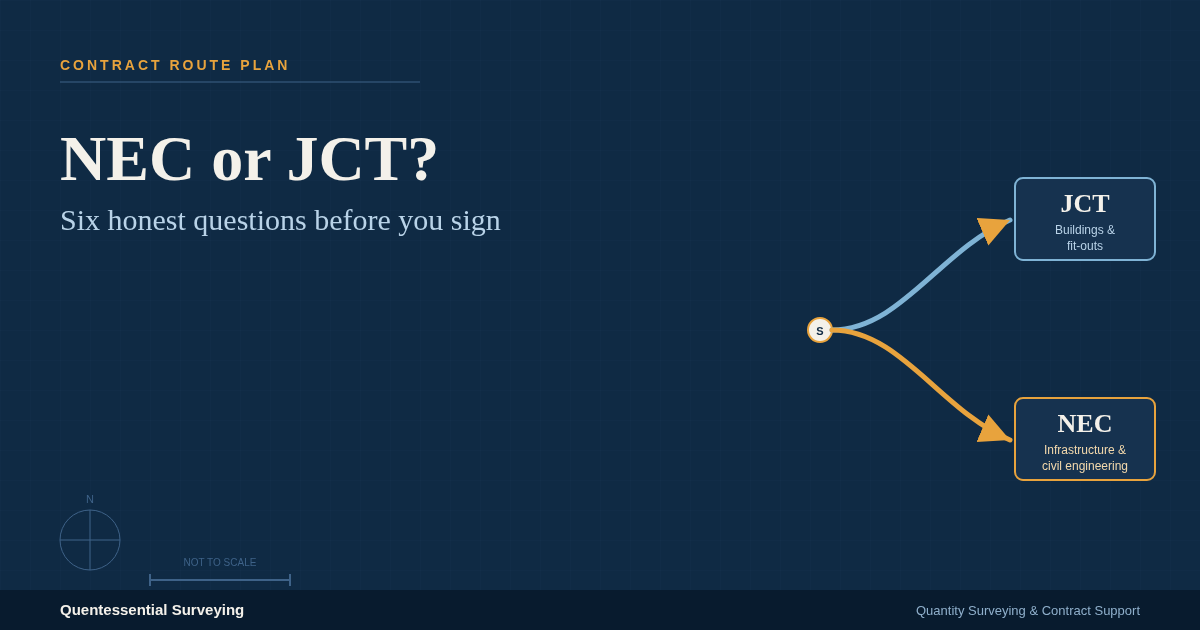
Two contractors walk into a site meeting. One’s clutching a JCT contract, the other’s clutching the new engineering contract (NEC, to its friends), and neither has actually finished reading it. No judgment — we’ve all nodded along in a meeting while secretly wondering “what is a contract, really, and why is it 400 pages.”
That’s basically the origin story of most construction disputes. Someone inherited a contract template, signed it because it was Tuesday, and three months later a “small variation” turned into a legal headache nobody budgeted for. Contractors chase payment, subcontractors chase contractors, and everyone quietly Googles “contract dispute resolution” at 11pm.
In this guide, you’ll answer six honest questions about your project, your risk appetite and your patience for paperwork — no law degree, no jargon, and (mostly) no falling asleep. We’ve also added a comparison table, a decision tree, real dispute statistics, and a rundown of the objections we hear most often, so you can make the call without opening a second browser tab.
Why Trust This Guide
At Quentessential Surveying, we advise contractors, developers, subcontractors and employers on procurement strategy, contract administration and commercial management across residential, commercial and infrastructure projects. Our team has:
- Administered both JCT and NEC4 forms as Contract Administrator and Project Manager
- Prepared and agreed final accounts across traditional, design and build, and two-stage procurement routes
- Supported clients through compensation events, early warnings, payment notice disputes and statutory adjudication
The observations in this guide reflect practical experience supporting projects from tender through final account, not just a read-through of the contract wording.
What Is a Contract, Anyway? (Besides a Thing Everyone Signs and Nobody Rereads)
Before we get diagnostic, let’s rewind to basics — because half of all contract disputes start with someone assuming a signed contract means “we’re all on the same page,” when really it means “we all signed the same document without reading the same pages.”
A contract is a legally binding agreement setting out each party’s obligations, payment terms and remedies if things go wrong. It works by allocating risk, defining scope and fixing how disputes get resolved. It is most commonly used to protect both employer and contractor once work begins on site.
Commercial contracts in construction usually juggle three things at once: a price mechanism, a program, and a change-control process. Mess up any one of those, and construction contract management stops being proactive and starts being a fire drill.
Why “one size fits all” fails spectacularly
A contract for services agreement built for a small fit-out will not survive first contact with a three-phase infrastructure scheme. It just won’t.
The real cost of guessing
Renegotiating terms mid-project costs more time, money and goodwill than picking the right construction contract types before tender. It’s also the exact failure the statistics in section 7 below put a number on.
What Type of Project Are You Delivering? (The First Step in Choosing Between JCT Contracts and NEC)
This is the first honest question, and it sorts more than people expect. A motorway does not behave like an office fit-out, and pretending otherwise is how contracts end up fighting the project instead of running it.
Construction contract types split broadly into civil engineering and infrastructure forms and building and construction forms. Civil engineering projects favour collaborative, management-focused contracts. Building projects favor forms with established procurement routes and familiar administrative roles.
NEC contracts were built for engineering and infrastructure work and remain the default on major UK government schemes — the Cabinet Office mandates NEC contracts on public sector construction projects above a set value (Legal Foundations, 2026). NEC4 is published and maintained by the Institution of Civil Engineers (ICE), and the UK Government’s Construction Playbook, overseen by the Infrastructure and Projects Authority, effectively requires it on publicly funded construction work. If your project looks more like a building than a bridge, JCT construction contracts — produced by the Joint Contracts Tribunal since 1931 — are the well-worn path.
A £500,000 office refurbishment with completed drawings generally suits a JCT Design and Build Contract — the scope is fixed, so a familiar, well-documented route keeps things moving.
A £40 million highway improvement with changing utilities generally benefits from NEC4 ECC — the scope will shift as ground conditions and utility diversions become clearer, and NEC’s compensation-event process is built for exactly that.
Signals you’re heading toward NEC
Highways, utilities, rail, or civil schemes where the scope is still finding its feet.
Signals you’re heading toward JCT
Commercial fit-outs, residential builds, and projects with a design that’s already locked in at tender.
Who Is Carrying the Design Risk on This Job? (JCT Design and Build vs NEC Option X15)
Design responsibility is the checkpoint everyone skips until a defect turns up and two teams point at each other. Whoever holds design risk should also hold the matching duty-of-care obligations — otherwise someone’s getting an unpleasant surprise.
Design risk allocation determines whether the employer’s design team or the contractor is liable for design errors. It works through clauses setting a reasonable-skill-and-care duty, or a stricter fitness-for-purpose standard. It is most commonly addressed through secondary design options or a design-and-build contract form.
JCT’s 2024 Design and Build Contract now limits the contractor’s design duty to reasonable skill and care, dropping any implied fitness-for-purpose obligation unless the contract says otherwise (Reed Smith, via Passle, 2024). NEC4 does something similar through its Option X15 design liability clause.
A residential developer engaging a contractor to design and build a 40-unit scheme typically uses JCT DB with Option X15-style skill-and-care wording mirrored into the appointment — the employer wants one point of contact, not a design team and a contractor blaming each other.
If the employer’s team designs
A traditional route, where the contractor builds to someone else’s drawings, needs less contractor-side design cover.
If the contractor designs
Design-and-build routes need clear liability caps and genuinely adequate professional indemnity insurance — not “should be fine, probably.”
How’s Your Tendering and Construction Procurement Going to Work?
Tendering is where the contract’s real personality gets decided, long before anyone signs. Skip this diagnostic and you risk pricing a project one way, then contracting it another — the construction equivalent of ordering a pizza and getting a salad.
Tendering in construction is the process of inviting contractors to submit priced bids against a defined scope. It works by comparing quality, price and program against fixed evaluation criteria. It is most commonly used to select a contractor before a signed contract is executed.
Well-defined scopes suit single-stage tendering and fixed-price options. Vaguer scopes suit two-stage tendering, bringing the contractor in early to shape buildability. Settle construction procurement routes before finalizing the contract form, not after — JCT’s updated tendering practice notes now cover recent developments in public and private sector tendering (Practical Law, 2024). The Procurement Act 2023, which took effect in February 2025, has also reshaped public sector tendering more broadly, tightening transparency and supplier accountability requirements that both JCT and NEC projects now sit within.
Two-stage vs single-stage tendering
Two-stage brings the contractor in early; single-stage assumes the design is already finished (bless).
Matching the tender to the contract
A contract for services promising cost certainty should not be paired with a scope that’s still a work in progress.
Do You Have the Contract Administration Capacity for NEC or JCT?
Some forms want a weekly check-in and a spreadsheet; others want a light touch and a Christmas card. Know which one you’re signing up for before the first early warning notice lands in your inbox.
Construction contract administration is the ongoing management of a signed contract’s payments, instructions and notices. It works through certificates, valuations and formally recorded variations issued as work proceeds. It is most commonly used to keep program, cost and quality aligned with the contract terms.
NEC’s early-warning and compensation-event process is more hands-on than a typical JCT construction contract — it rewards teams who actually turn up to the meetings. No dedicated contract administrator on the team? A simpler JCT form may suit your resourcing better than a full NEC main option.
The Contract Administrator’s role
Under JCT forms, the Contract Administrator (or Architect/Employer’s Agent, depending on the procurement route) certifies payment, issues instructions, agrees extensions of time and certifies practical completion. Under NEC4, the equivalent function sits with the Project Manager, who assesses compensation events, responds to early warnings and instructs changes — the title’s different, but the accountability is broadly the same.
The Quantity Surveyor‘s role
A Quantity Surveyor typically sits alongside the Contract Administrator or Project Manager, valuing works in progress, pricing variations and compensation events, checking payment applications, and preparing the final account. On NEC projects this work often runs through the Project Manager’s compensation-event assessments; on JCT projects it usually feeds directly into interim valuations and certificates.
Compensation events, in plain English
A compensation event is NEC’s mechanism for dealing with anything that changes the contractor’s cost or program — a late instruction, a change in scope, adverse ground conditions not reasonably foreseeable, and so on. The contractor notifies the event, the Project Manager instructs a quotation, and the price and program are adjusted before the work is even carried out, rather than argued over at the end. It is the single biggest reason NEC needs more active administration than JCT.
Early warning
An early warning is a notice either party gives as soon as they become aware of anything that could increase cost, delay completion, or affect performance. It triggers an early warning meeting where the risk is discussed and, ideally, managed before it becomes a formal claim. JCT has no direct equivalent — its notice provisions are narrower and generally reactive rather than continuous.
Payment notices
Both JCT and NEC operate within the payment notice framework set by the Housing Grants, Construction and Regeneration Act 1996 (as amended). A payment notice sets out the sum considered due and the basis of calculation; a pay less notice, if the paying party intends to pay less than the notified sum, must be issued by the relevant deadline or the notified sum becomes payable in full. Missed payment notices are one of the most common — and most avoidable — sources of adjudication.
Final account
The final account is the process of agreeing the total sum due to the contractor once the works are complete, incorporating all variations, compensation events, loss and expense claims, and retention release. Under JCT, this is formalized through the Final Certificate; under NEC4, through the final assessment of the Price for Work Done to Date. Delays in agreeing the final account are a frequent trigger for late-stage disputes on both forms.
Signs you can handle NEC
A dedicated project manager, regular early-warning meetings, and someone who actually enjoys record-keeping.
Signs a lighter-touch JCT form suits you better
A small team, a well-defined scope, and a healthy fear of weekly admin.
How Much Contract Dispute Drama Can Your Project Handle?
Every construction contract builds dispute resolution in from day one — the difference is how hard it tries to avoid a fight before it starts. Answer this honestly, not aspirationally.
Contract dispute resolution in construction typically follows negotiation, adjudication, then arbitration or litigation if needed. It works by giving either party a fast, binding adjudication decision, usually within 28 days. It is most commonly used to resolve payment and variation disputes without halting the works.
Either party can refer a contract dispute to adjudication at any time under the Housing Grants, Construction and Regeneration Act 1996, whichever form you use. NEC4 adds a formal Dispute Avoidance Board (Option W3) and a senior representative negotiation step before adjudication. JCT’s 2024 suite now makes senior-level dispute negotiation mandatory, although these provisions do not override the parties’ statutory right to adjudication.
A subcontractor disputing a rejected variation on a JCT project generally starts with senior-level negotiation under the 2024 suite, then adjudication if that stall — most disputes settle before either party sees a courtroom.
Low appetite for drama
Favor forms with mandatory early negotiation, clear notice deadlines, and properly resourced contract administration.
Higher tolerance, higher-stakes projects
Larger, riskier schemes sometimes accept more formal dispute mechanisms in exchange for clearer risk allocation.
JCT vs NEC at a Glance
| JCT | NEC4 | |
|---|---|---|
| Best suited to | Commercial, residential and public building projects | Infrastructure, civil engineering and public sector schemes |
| Publishing body | Joint Contracts Tribunal (est. 1931) | Institution of Civil Engineers (current edition published 2017) |
| Design liability | Reasonable skill and care by default under the 2024 DB suite | Reasonable skill and care via Option X15 |
| Change management | Instructions and variations, valued after the fact | Compensation events, priced and agreed before work proceeds |
| Risk warning mechanism | Notice provisions, generally reactive | Early warning register, continuous through the project |
| Day-to-day administrator | Contract Administrator / Employer’s Agent / Architect | Project Manager |
| Admin intensity | Lighter touch, periodic certificates | Higher touch, regular early-warning meetings |
| Dispute avoidance | Mandatory senior-level negotiation (2024 suite) before adjudication | Senior representative negotiation, plus optional Dispute Avoidance Board (Option W3) |
| Statutory adjudication | Available under the Construction Act, as with all UK construction contracts | Available under the Construction Act, as with all UK construction contracts |
| Public sectors use | Common on building-sector public projects | Mandated by the Cabinet Office above threshold on public sector construction |
| Typical procurement fit | Traditional, design and build, minor works | Options A–F pricing mechanisms, from priced to cost-reimbursable |
Quick Decision Tree
For the genuinely undecided, here’s the shortest version of this entire article:
Is your project infrastructure, civils, or utilities?
        │
   ┌────┴────┐
  YES        NO
   │          │
   │          └── Is your design already fixed at tender?
   │                    │
   │              ┌─────┴─────┐
   │             YES          NO
   │              │            │
   │        JCT (traditional JCT Design
   │         or DB with a     and Build,
   │         defined scope) Option X15-style
   │                          liability wording
   │
Is the scope likely to change during delivery
(ground conditions, utility diversions, phasing)?
        │
   ┌────┴────┐
  YES        NO
   │          │
  NEC4 ECC   NEC4 with a
  Option C   simpler main
  or E       option, or a
  (target    JCT form if the
  cost /     scope is genuinely
  cost       fixed
  reimbursable)
If you land on more than one branch, that’s usually a sign the project genuinely sits on the fence — see the “still not sure” section at the end.
What the Numbers Actually Say
Most articles on this topic run on opinion. Here’s what the data shows:
- Inadequate contract administration and a lack of competence among contract participants were named as the two leading causes of UK construction disputes referred to adjudication, at 50% and 42% of respondents respectively, according to research from King’s College London’s Centre of Construction Law and Dispute Resolution .
- UK adjudication referrals reached 2,264 between May 2023 and April 2024, a 9% rise on the previous year and the highest figure on record, with the same research showing most adjudications concluding within 29 to 42 days, though only 16% of respondents saw the strict 28-day statutory period actually followed [King’s College London’s Centre of Construction Law and Dispute Resolution].
- Adjudicator fees were most commonly reported between £12,001 and £14,000 in total, according to the same survey [King’s College London’s Centre of Construction Law and Dispute Resolution] .
- UK construction disputes take an average of 9.8 months to resolve, the fastest of any region surveyed globally, down from 12.8 months in 2018, per Arcadis’ Global Construction Disputes Report as reported by Construction Management.
- A failure to make interim awards on extensions of time and compensation has ranked as a top cause of UK construction disputes, alongside poor contract administration more broadly — both squarely within the territory this guide addresses [Construction Management].
The pattern across every source is the same: it’s rarely the contract wording itself that causes disputes. It’s how well — or badly — the contract is administered once it’s signed.
Where JCT and NEC Actually Do Their Job: The Project Lifecycle
The questions above map onto real stages of a project, from tender to final account. Here’s where each one actually bites.
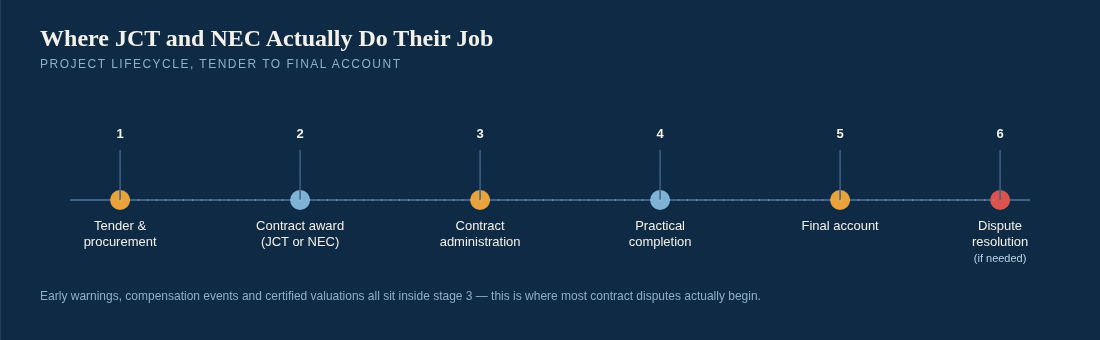
Most contract disputes trace back to the contract administration stage — where early warnings, valuations and variations either get recorded properly or don’t. Get procurement and contract award right, using the diagnostic questions above, and administration becomes far easier to manage.
Frequently Asked Questions
Is NEC always better?
No. NEC’s collaborative machinery only pays off if someone is actually resourced to run it — early warnings, compensation events and the risk register all need active management. On a small, well-defined project, that overhead can cost more in admin time than it saves in avoided disputes.
Is JCT outdated?
No — the 2024 suite was a substantial update, tightening design liability, adding mandatory senior-level dispute negotiation, and refreshing tendering guidance. JCT remains the dominant form for UK building-sector work for good reason: it’s well understood, and decades of case law mean disputed clauses usually already have a court judgment behind them.
Can small projects use NEC?
Yes — the Engineering and Construction Short Contract (ECSC) exists specifically for lower-risk, less complex projects that don’t need the full ECC machinery.
Can infrastructure projects use JCT?
Technically yes, but it’s uncommon and rarely advisable. JCT’s administrative and change-control mechanisms weren’t built for evolving civil engineering scope, and public sector clients are usually required to use NEC above a threshold value in any case.
Is NEC more expensive to run?
Administratively, often yes — the early-warning and compensation-event process needs more regular meetings and record-keeping than a typical JCT contract. Whether that costs more overall depends on whether it prevents the kind of disputes that are far more expensive to resolve later.
Does NEC actually reduce disputes?
The evidence points to fewer disputes where the collaborative mechanisms are actually used as intended — early warnings raised promptly, compensation events assessed on time. Where they’re treated as a paperwork exercise, NEC projects can end up with the same disputes as any other contract, just under a different name.
Which contract is easier to administer?
JCT, generally, for a team without a dedicated project manager or the appetite for weekly risk meetings. NEC rewards teams that already run tight program and risk management; it doesn’t create that discipline on its own.
Can contracts be amended?
Yes, both JCT and NEC allow bespoke amendments — JCT through schedules of amendments, NEC through Z clauses. Amendments should be drafted carefully and reviewed by someone who understands how they interact with the standard mechanisms; poorly drafted bespoke clauses are themselves a common source of disputes.
What is the difference between NEC and JCT contracts?
NEC contracts are collaborative, management-focused forms built for engineering and infrastructure work, while JCT contracts are established building-sector forms suited to commercial and residential projects with a more defined design at tender.
What is the new engineering contract used for?
The new engineering contract, or NEC, is most commonly used for UK infrastructure, civil engineering and public sector projects, particularly where scope may evolve during delivery.
What are JCT contracts used for?
JCT contracts are used for commercial, residential and public building projects across England and Wales, covering traditional, design-and-build and minor works procurement routes.
What is contract administration in construction?
Contract administration is the ongoing management of a signed contract, including certifying payment, recording instructions and processing variations as the works proceed.
How is a construction contract dispute usually resolved?
Most construction contract disputes move through negotiation first, then statutory adjudication under the Housing Grants, Construction and Regeneration Act 1996, with arbitration or litigation reserved for unresolved cases.
Is NEC legally binding?
Yes. NEC4 is a standard form contract like any other — once executed, its terms are as legally binding as a JCT contract, and it sits within the same statutory framework for payment and adjudication.
Is JCT only used in the UK?
JCT is primarily used in England and Wales, though its forms have influenced contract drafting elsewhere. NEC, by contrast, has been adopted internationally, including in Hong Kong, Singapore, South Africa and parts of the Middle East and Australia.
Which is cheaper — JCT or NEC?
Neither form is inherently cheaper; the contract price is set by the works, not the paperwork. NEC’s active management style tends to carry higher day-to-day administration costs, which some clients offset against fewer late-stage disputes.
Which contract reduces disputes more effectively?
Both can, if administered properly. NEC’s early-warning and compensation-event process is designed to resolve issues as they arise rather than at the end; JCT’s 2024 suite added mandatory senior-level negotiation for the same reason. The evidence consistently points to contract administration quality, not the choice of form, as the biggest single factor in dispute rates.
Can you switch contracts mid-project?
Not in the sense of swapping the underlying form — that would mean terminating and re-executing the agreement, which is disruptive and rarely done. What can change is how a contract is amended or supplemented as the project develops, through variations, Z clauses, or schedules of amendment.
Who prepares the contract?
On JCT projects, this is usually the Contract Administrator, Employer’s Agent or a solicitor, working from the relevant JCT template. On NEC projects, it’s typically the Project Manager or a quantity surveyor selecting the appropriate main and secondary options, often with legal input on Z clauses.
Can subcontractors use NEC?
Yes — the NEC4 suite includes a dedicated Engineering and Construction Subcontract (ECS), designed to mirror the main contract’s structure and terminology down the supply chain.
Conclusion
The right contract isn’t the one you used last time, or the one already saved in the shared drive — it’s the one matching your project type, your design risk, your procurement route and your team’s genuine appetite for admin. Work through these questions honestly, check them against the table and decision tree above, and choosing between JCT contracts and the new engineering contract stops being guesswork. Get the diagnosis right, and construction contract management stops being reactive.
Still Not Sure Which One’s Yours?
Fair enough — some projects genuinely sit on the fence, and no blog post (however charming) replaces an actual conversation. Speak to us about the Quantity Surveying, Contract Administration, Cost Planning, Tendering, Procurement and Commercial Management support your project needs, and we’ll help you pick the right contract and keep it under control from day one.
vorbelutr ioperbir
12 Oct, 2026I believe you have observed some very interesting details , thanks for the post.