Contract Administration in Construction: A Complete 2026 Guide
Nearly every construction dispute traces back to one weak point: poor contract administration. When paperwork drifts out of sync with the work on site, costs climb and trust breaks down fast.
You manage tight margins, shifting scopes, and subcontractors who all read the contract differently. One missed variation or vague clause can wipe out a project’s profit. Most teams only notice the gap when a claim lands.
In this guide, you will discover how construction contracts, procurement, and dispute resolution actually work — without drowning in legal jargon. You will learn the practices that keep projects controlled from tender to final account.
A structured approach to contract administration keeps construction projects on budget and dispute-free.
What Is Contract Administration in Construction?
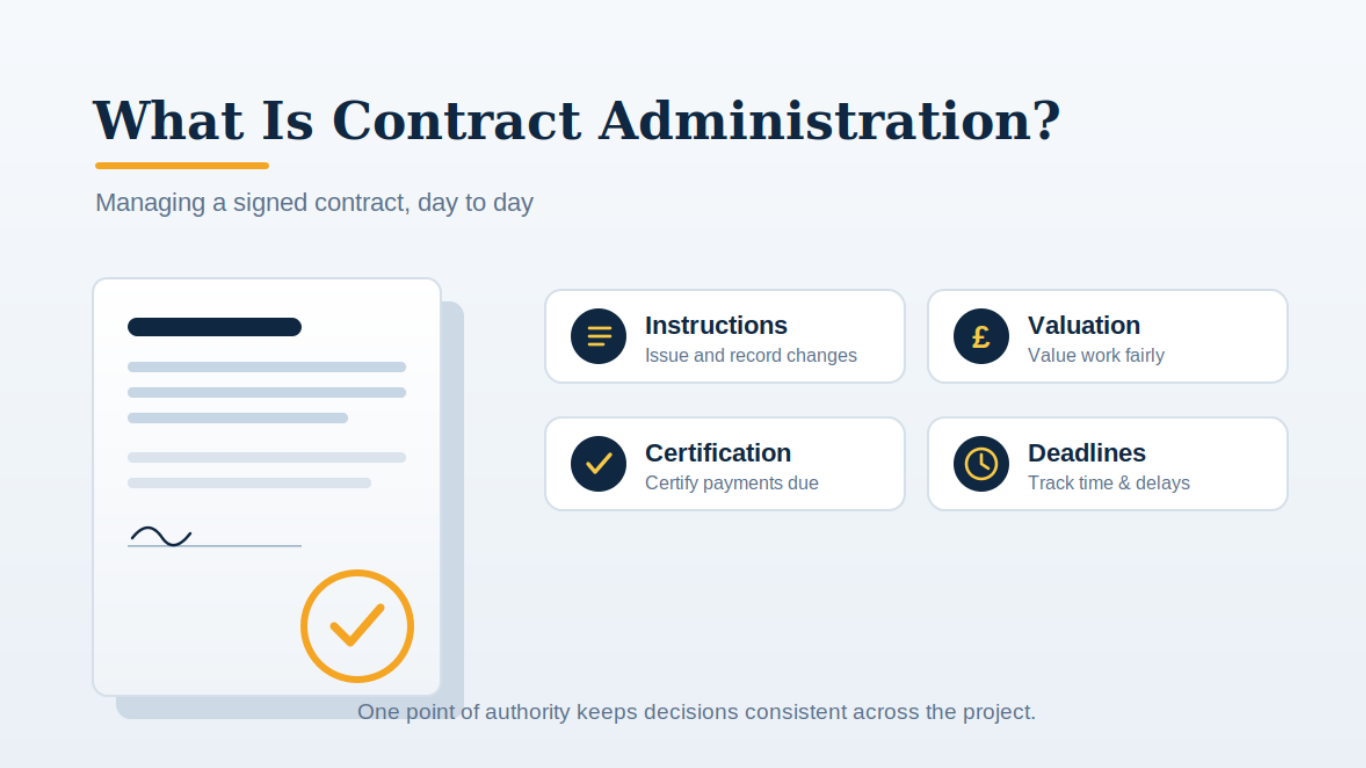
Contract administration turns a signed construction contract into enforceable day-to-day action.
Strong projects start with clear roles. Contract administration is the engine that keeps obligations, payments, and timelines aligned. Without it, even a well-drafted construction contract fails in practice.
Contract administration is the day-to-day management of a construction contract after it is signed. It works by tracking obligations, payments, variations, and deadlines against agreed terms. Most teams use it to protect scope, control cost, and prevent contractual disputes.
An administrative contract sets the rules; contract administration enforces them. This covers instructions, valuations, extensions of time, and certification. On UK projects, JCT and NEC forms shape how these duties are carried out.
In practice, the form of contract sets the tone. Standard JCT contracts, for example, name a dedicated contract administrator to issue instructions, value work, and certify payment. That single point of authority keeps decisions consistent across the project.
Contract Administration vs Contract Management
People mix these terms often. Contract management is the wider strategic cycle. Contract administration is the operational layer that executes it on site.
Why It Matters for Every Stakeholder
Architects, engineers, and project managers all rely on accurate records. Clear construction contract administration turns a signed document into predictable, enforceable action. Our contract administration service supports teams across every stage of a project.
How Does Construction Procurement and the Tendering Process Work?
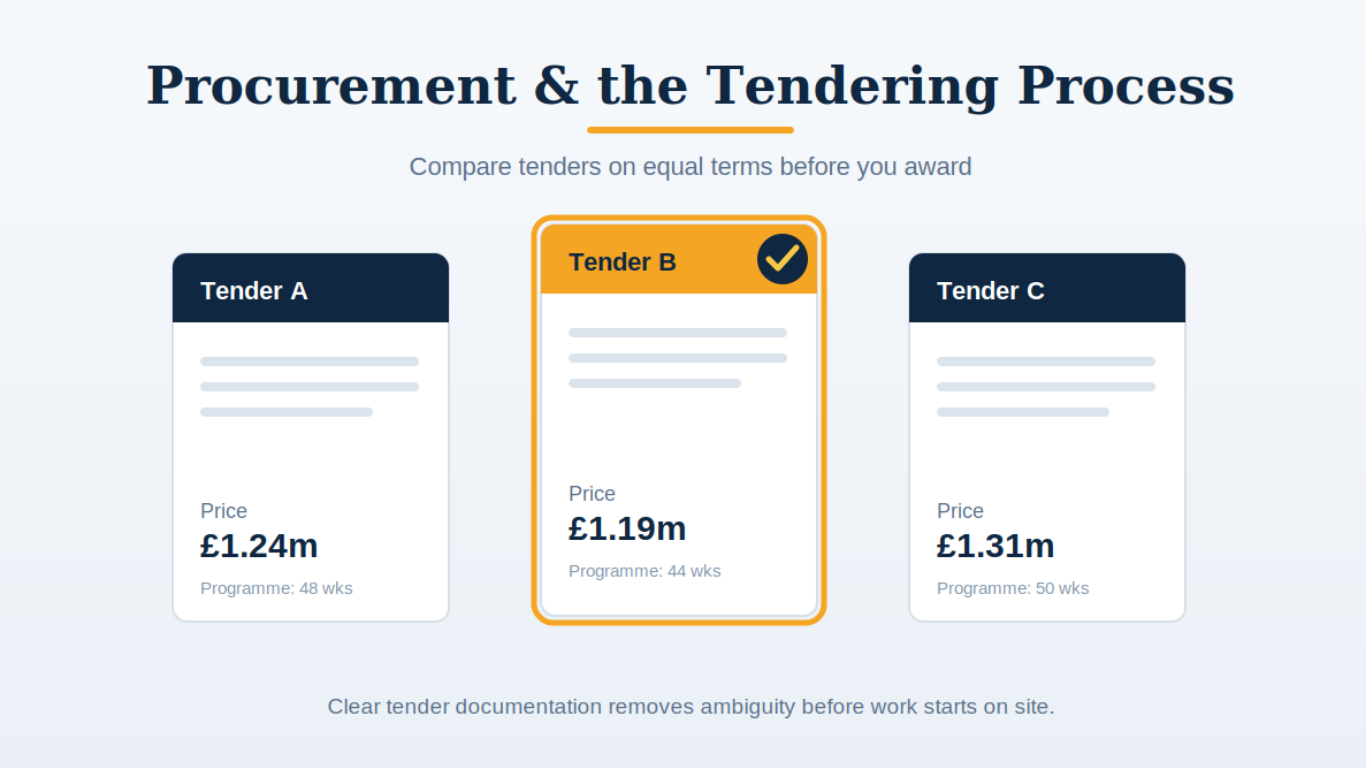
Clear tender documentation removes ambiguity before work starts on site.
Procurement decides who builds your project and on what terms. Get it wrong and every later stage suffers. Strong procurement in construction sets the foundation for clean contract administration.
Construction procurement is the process of selecting contractors and suppliers to deliver a project. It works by defining requirements, inviting bids, and awarding a contract. Most owners use a formal tendering process to secure fair price and quality.
The tendering process moves from tender preparation to tender documentation, then evaluation and award. Good tender documents remove ambiguity before a single brick is laid. Weak documents invite variations and claims later.
Owners searching for “general contractors near me” should still run structured tender preparation, not just pick the nearest name. A construction tender compared on equal terms protects budget and programme.
Common Construction Procurement Routes
- Traditional: design finishes before tender; strong cost certainty.
- Design and build: one contractor handles design and delivery.
- Management routes: work packages let procurement and construction overlap.
What Are the Main Construction Contract Types?
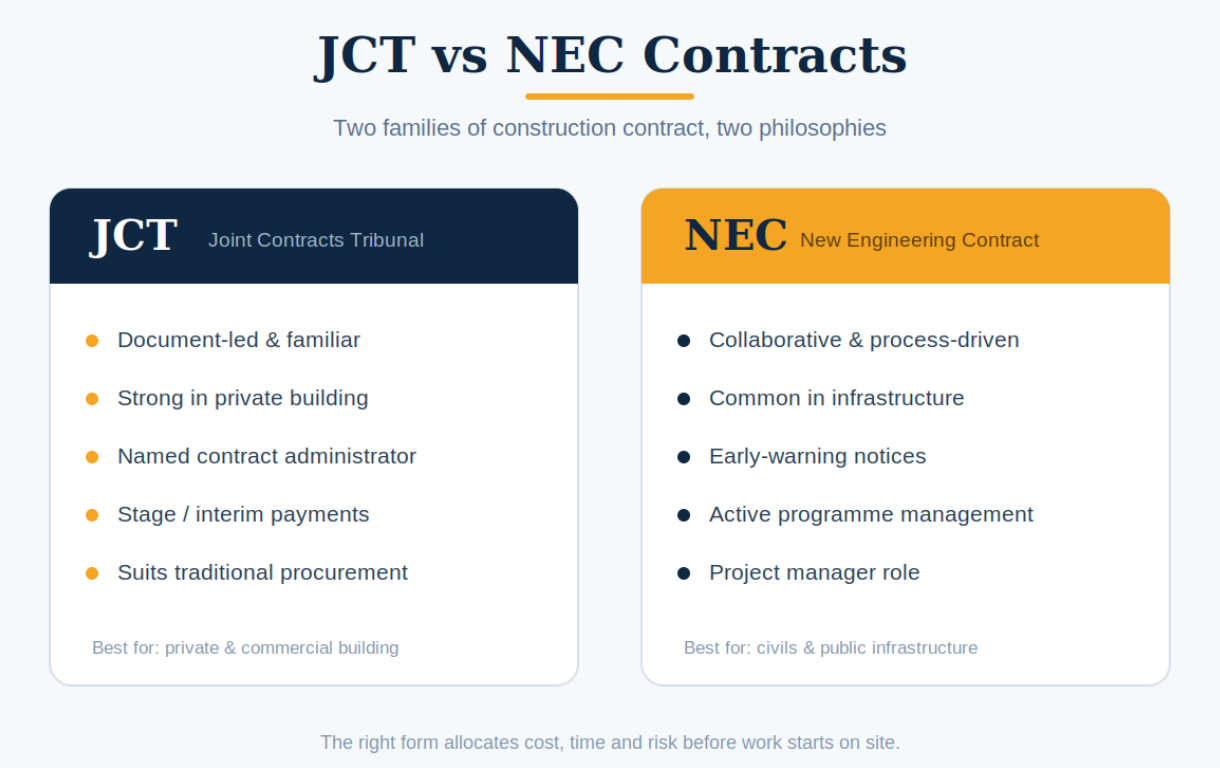
JCT versus NEC construction contract types comparison showing key differences
Choosing the right form controls risk from day one. Different construction contract types allocate cost, time, and responsibility very differently. The wrong choice creates friction no amount of goodwill can fix.
Construction contract types are standard forms that define how risk and payment are shared. They work by fixing terms for price, variations, and disputes upfront. UK teams most commonly use JCT and NEC contracts across building and civil projects.
JCT construction contracts suit traditional building work and stage payments. NEC contracts, including the NEC3 contract and its successors, focus on collaboration and active project management. A new engineering contract emphasises early-warning notices and clear programmes.
Ask “what are JCT contracts” and the answer is a family of forms for common building scenarios. Ask “what is a NEC contract” and you get a flexible, process-driven approach. You can compare NEC forms at neccontract.com (NEC, 2026).
JCT vs NEC at a Glance
- JCT builders contract: familiar, document-led, strong in private building.
- NEC / new engineering contract: proactive, programme-focused, common in infrastructure.
Fixed Price vs Remeasurable
Commercial contract choices are also split by pricing. Lump-sum forms fix cost; remeasurable forms price the work actually done.
How Do You Manage Contract Variation and the Contract Management Cycle?
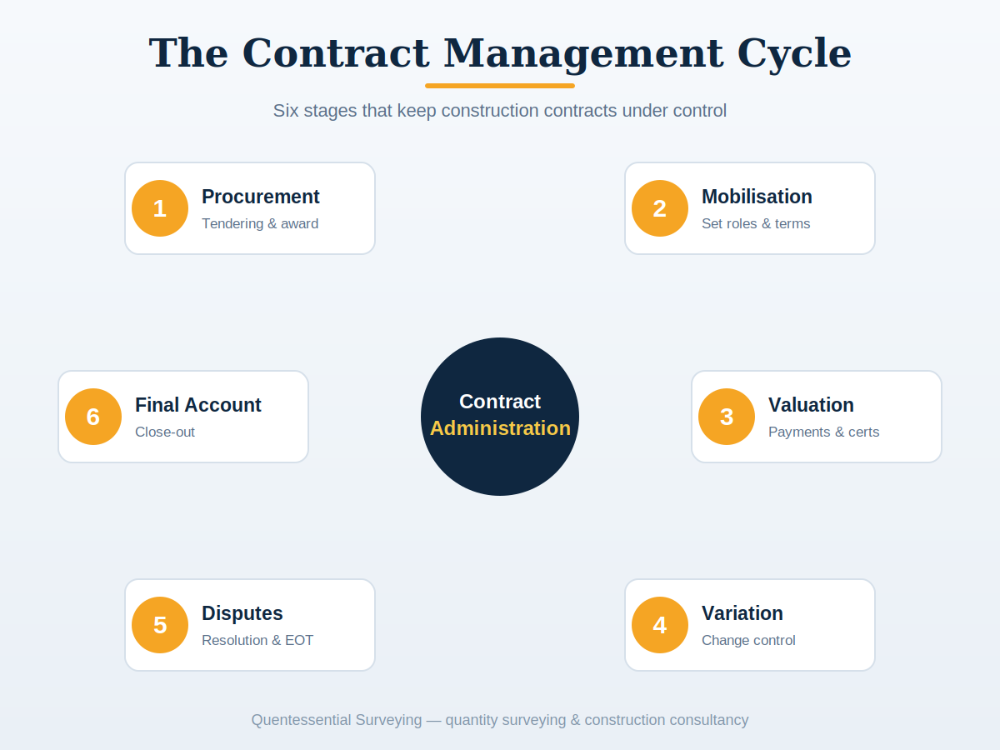
The contract management cycle runs from procurement through to final account.
Change is inevitable on site. What matters is how you record and value it. A disciplined contract management cycle turns every variation to contract into a controlled, paid event.
A contract variation is an agreed change to the original scope, price, or programme. It works by issuing a formal instruction, then valuing and certifying the change. Teams use it to keep contract administration accurate as the project evolves.
The contract management process runs from award through delivery to close-out. Contract variation slots into this contract management cycle at every stage. Skip the paperwork and you convert legitimate change into a contractual dispute.
For example, a verbal instruction with no written variation is hard to recover at final account. Contract management in procurement links each change back to the agreed commercial contract.
Steps to Handle a Variation
- Receive or issue a written instruction.
- Price the change against contract rates.
- Certify and update the running total.
What Happens During Contract Disputes and Dispute Resolution?
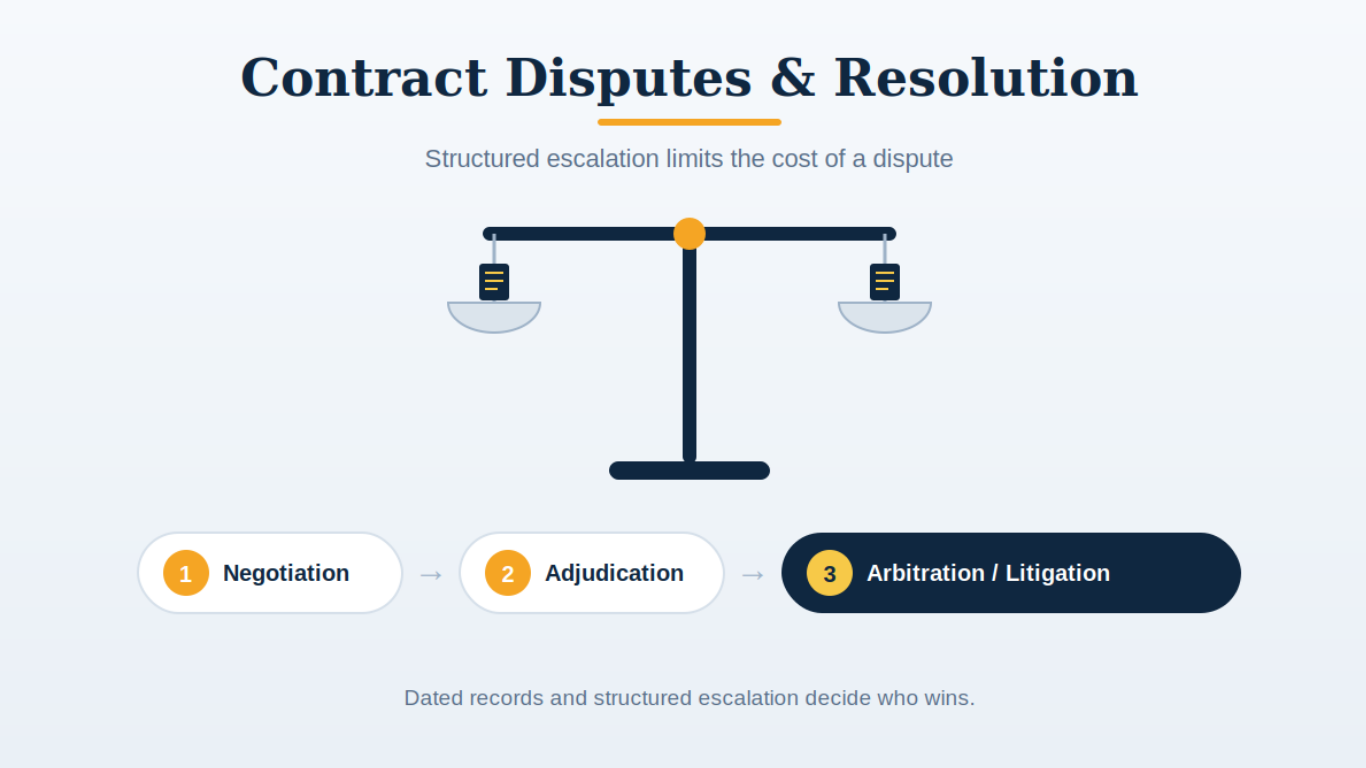
Dated records and structured escalation limit the cost of contractual disputes.
Disputes cost time, cash, and relationships. Fast, structured resolution limits the damage. Good contract administration prevents most contract disputes before they escalate.
A contract dispute is a disagreement over obligations, payment, or scope under a contract. It works through negotiation, then formal routes like adjudication if needed. Most UK construction contracts include a dispute resolution appointment procedure.
Under UK law, parties to most construction contracts hold a statutory right to adjudication. This gives a fast, binding decision that keeps cash flowing. The right comes from the Housing Grants, Construction and Regeneration Act 1996, viewable at legislation.gov.uk (UK Government, 1996).
Clear records are your strongest defence in contractual disputes. Dated instructions, valuations, and correspondence decide who wins.
Mini case study — BAS Brickwork: Quentessential Surveying provided contractual and commercial support around payment applications and disputed valuations. By intervening to challenge under-certification, recent work contributed to certification increasing from roughly £24,000 to £80,000, with further contractual entitlement still being established.
See more results in our construction case studies, or learn about our commercial and contractual support.
The Escalation Ladder
- Negotiation: direct, cheapest, fastest.
- Adjudication: statutory, quick, binding on an interim basis.
- Arbitration or litigation: final, formal, slower.
What Is Subcontracting and How Do Subcontractor Agreements Work?
Back-to-back subcontractor agreements keep payment and dispute terms consistent down the chain.
Main contractors rarely self-deliver every trade. Subcontracting spreads work and risk. Weak subcontractor agreements pull that risk straight back to you.
Subcontracting is hiring specialist firms to deliver defined packages of work. It works through a subcontractor contract that mirrors the main contract terms. Teams use it to manage capacity while keeping obligations flowing down cleanly.
A subcontractor agreement should back-to-back the main construction contract. That way, payment, variation, and dispute terms stay consistent. A poorly drafted sub-contract leaves gaps that surface at the worst moment.
For example, mismatched payment dates between main and sub-contract can breach statutory payment rules. Aligned terms protect cash flow across the whole chain. Subcontractor payments in the UK also fall under the Construction Industry Scheme, which sets how contractors handle tax deductions (HMRC, 2024).
Mini case study — Specialist Subcontractors: Quentessential Surveying gives ongoing commercial support to subcontractors including BAS and Leighway. This spans payment applications, variations, remeasurement, disruption, extensions of time, and final accounts — stepping in where handover information is incomplete.
For Leighway, which delivers brickwork and construction projects, that support runs across a live portfolio including Flagship School, Open Gates, and Melbourne. Remeasuring project drawings has identified changes and additional commercial entitlement across those schemes.
Back-to-Back Basics
- Mirror payment and notice timing.
- Flow down variation and dispute clauses.
- Define scope with zero overlap or gaps.
Conclusion
Solid contract administration protects your programme, your margin, and your working relationships. Choose the right construction contract types early, whether JCT or NEC. Record every contract variation and run disputes through a clear, structured process.
Do these three things well and most claims never reach a formal fight. Contract administration is not paperwork for its own sake — it is how disciplined teams stay in control from tender to final account.
Frequently Asked Questions
What do you mean by contract administration?
Contract administration means managing a construction contract after both parties sign it. It covers instructions, valuations, payments, variations, and certification. The goal is to keep the project aligned with agreed terms from start to final account.
What does a contract administrator do?
A contract administrator issues instructions, values work, certifies payments, and manages variations and extensions of time. They act as an impartial party under the contract. Their day-to-day work keeps cost, time, and scope under control.
What is the difference between contract administration and contract management?
Contract management is the wider strategic cycle covering procurement, negotiation, and performance. Contract administration is the operational layer that executes those terms on a live project. In short, management sets direction; administration delivers it day to day.
What are the stages of contract administration?
The main stages run from award and mobilisation through instructions, valuations, and variation control, then extensions of time, certification, and final account. Each stage keeps records aligned with the construction contract. Clean records at every stage prevent disputes later.
Who appoints the contract administrator?
The employer or client usually appoints the contract administrator, often naming them directly in the contract. On JCT forms, this is a defined role. The administrator must still act fairly between both parties when certifying and valuing work.
What is another name for a contract administrator?
Depending on the contract form, a contract administrator may be called the employer’s agent, the project manager, or the supervising officer. NEC contracts use the term “project manager” for a similar role. The exact title depends on the construction contract type used.
Is contract administration the same as project management?
No. Project management directs the whole delivery of a project, including design, resources, and programme. Contract administration focuses only on enforcing the terms of the signed contract. The roles overlap but carry different duties and accountability.
What are three important functions of contract administration?
Three core functions are valuing and certifying payment, managing variations and change control, and administering time, including extensions and delays. Together these functions protect cost, scope, and programme. Strong records support each one if a dispute arises.
Speak to Us About Your Quantity Surveying Needs
Facing a tricky variation, a disputed final account, or a contract you are unsure about?
Get in touch today for expert support with contract administration, procurement, and commercial management on your next project.