This guide focuses on the UK legal framework for construction dispute resolution, including statutory adjudication under the Construction Act 1996. Some of what follows — negotiation and mediation, in particular — applies more broadly, but the contract references and legal mechanisms are UK-specific unless we say otherwise.
Introduction
Pick the wrong dispute resolution route and you can end up stuck in a process that costs more, takes longer, and damages a relationship you still need for the next project. Dispute Resolution in construction isn’t one process — it’s a menu of options, and choosing badly is often more expensive than the original disagreement ever was.
If you’ve sat in a meeting arguing over who authorized a variation, or watched a payment get withheld while both sides wait to see who blinks first, you know how fast a small disagreement can stall a project. The instinct is usually to call a solicitor straight away. That’s rarely the fastest or cheapest way through.
This guide works as a decision framework rather than a checklist. You’ll see what each dispute resolution route actually involves under UK construction law, what tends to cause disputes in the first place, and how quantity surveyors help prevent and manage them through solid contract administration — instead of reaching for the most expensive option out of habit.
This guide draws on published UK industry research, including reports from King’s College London’s Centre of Construction Law & Dispute Resolution and the Adjudication Society, and on practical experience advising contractors and property owners through live disputes.
Quick Comparison: Which Route Fits Your Dispute?
Before we go through each method in detail, here’s how the main routes compare on speed, cost, and how binding the outcome is under UK practice.
| Method | Typical Speed | Relative Cost | Binding | Best Suited For |
|---|---|---|---|---|
| Negotiation | Days to weeks | Low | No | Early scope or payment misunderstandings |
| Mediation | Weeks | Low–Medium | No, unless settled | Preserving an ongoing relationship |
| Construction Adjudication | Around 28 days, often longer by agreement | Medium | Yes (interim) | Urgent payment or delay disputes |
| Arbitration | Months | High | Yes (final) | High-value or technically complex disputes |
| Litigation | Often 12–18 months to trial | Highest | Yes (final) | Cases needing a binding precedent or where other routes failed |
Treat this as a starting point rather than a final answer — the sections below cover when it makes sense to move off this default path.
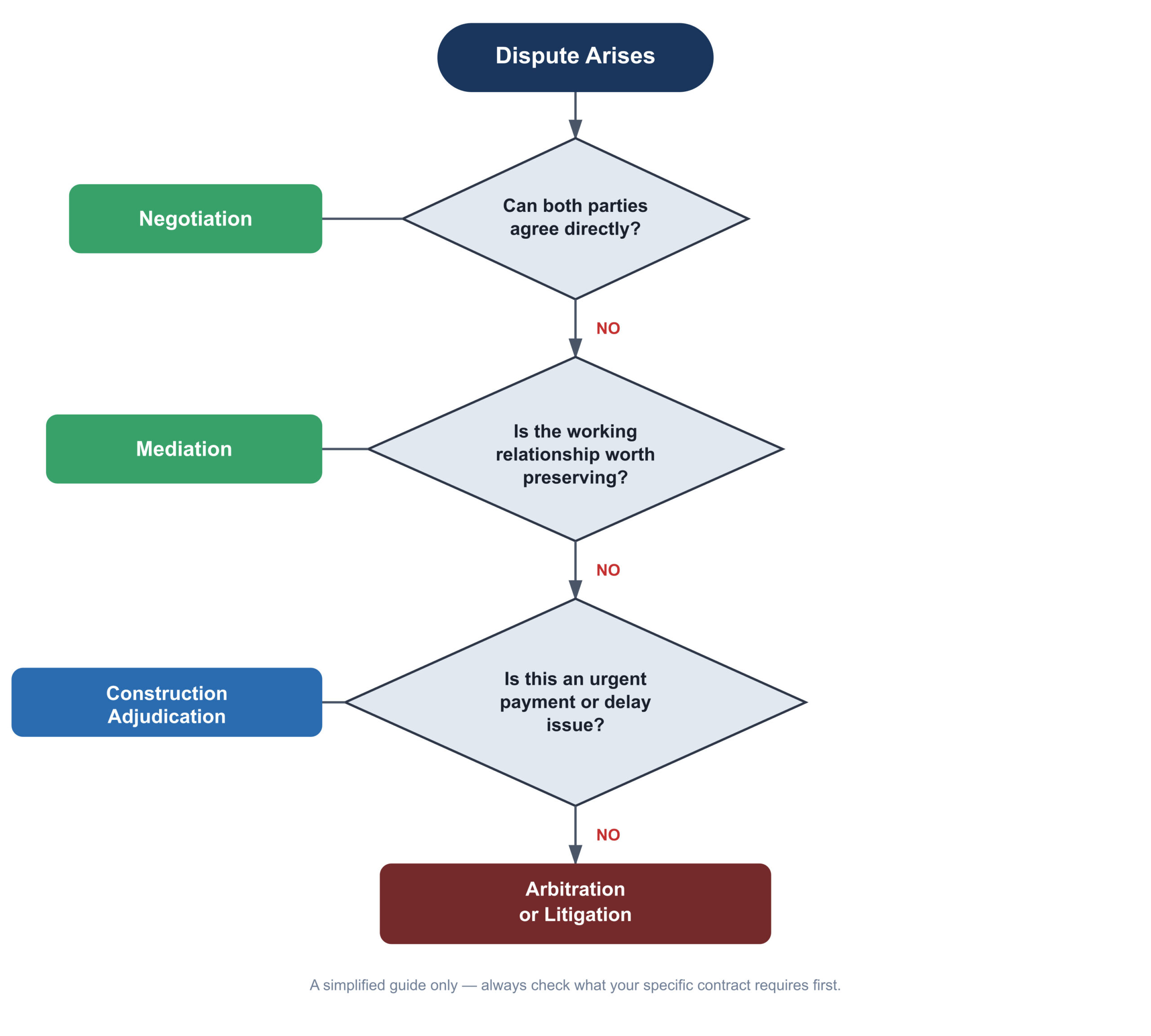
Decision Flow: Which Route Should You Take?
The table above shows the trade-offs. The flow below shows the order most disputes actually work through in practice.
What Is Dispute Resolution in the Construction Industry?
It’s worth pinning down the basics before picking a strategy, because the wrong method can lock parties into a slow, expensive process that a simpler route would have avoided. Construction projects bring together contractors, subcontractors, engineers, and owners, and each has different leverage and different contract obligations.
Put simply, dispute resolution in construction is the structured way project parties work through a disagreement — starting with informal talk and escalating, if needed, through mediation, adjudication, arbitration, or the courts. Most disputes fall into one of three buckets: payment, delay, or defects.
Most UK standard-form construction contracts set out a resolution pathway in advance. JCT and NEC contracts, for example, typically map out clear steps before a dispute can go to adjudication, arbitration, or court. The procurement route chosen at the outset — traditional, design and build, or construction management — also shapes how those contractual disputes provisions play out in practice.
Why Contracts Set a Tiered Process
Most modern contracts require an attempt at informal resolution first. It protects the working relationship and keeps legal spend down before things escalate.
Who’s Usually Involved
Owners, main contractors, subcontractors, and design consultants like architects and engineers all tend to have a stake in how a dispute plays out.
Why Timing Matters
The earlier a disagreement gets addressed, the cheaper and faster it is to sort out — evidence is fresher and nobody’s dug into a fixed position yet.
What Are the Most Common Causes of Construction Disputes?
Knowing why disputes happen is often more useful than knowing how to resolve them, since most causes are preventable with better contract administration and communication. It’s a question worth asking at the start of a project, not after the dispute has already landed.
Poor contract administration, unclear scope, and payment disagreements sit at the root of most construction disputes. They tend to surface through variations, delays, and defect claims — usually because documentation or communication fell short somewhere along the way.
According to the 2024 King’s College London and Adjudication Society report on UK statutory adjudication, inadequate contract administration was the single most cited cause of disputes — flagged by 50% of respondents — followed by a lack of competence among contract participants at 42% [King’s College London / Adjudication Society, 2024]. Exaggerated claims and client-driven changes each came up in around 30% of responses, with adversarial industry culture cited by roughly a quarter.
Poor Contract Administration
Missed notices, unclear variation instructions, and patchy record-keeping are, by a wide margin, the biggest driver of disputes — which is exactly why disciplined contract administration is often the cheapest form of dispute prevention going.
Payment and Valuation Disagreements
Interim valuations, final accounts, and “smash-and-grab” payment claims remain some of the most common categories referred to adjudication. Many of them trace back to figures that were never properly agreed at estimating stage, then resurface later as full-blown valuation disputes.
Delay, Loss, and Expense Claims
Who caused a delay, and who pays for it, is a recurring flashpoint — particularly on complex or fast-tracked projects where the causes of a slip are genuinely hard to untangle.
Should You Try Negotiation Before Anything Else?
Negotiation is almost always the first step, and for good reason: it’s free, private, and preserves the working relationship you need to finish the project. Jumping straight to formal proceedings can do lasting damage to a commercial partnership that would otherwise have survived a rough patch.
In a 2020 survey of UK respondents by Arcadis’s Contract Solutions team, more than 65% pointed to settlements reached before formal proceedings as the most common route to early resolution [Arcadis / The Construction Index, 2021]. Strong commercial management throughout the project keeps these conversations constructive rather than adversarial, so that when both sides are willing to problem-solve rather than assign blame, a third party is never needed at all.
What Makes Negotiation Succeed
Clear documentation — site records, recorded change orders — gives both parties facts to work from instead of opinions.
When Negotiation Typically Fails
It stalls when trust has already broken down, or when one side believes it holds the stronger legal ground and sees no reason to compromise.
What Is Mediation and When Should You Use It?
Mediation sits between informal negotiation and binding arbitration, and courts increasingly encourage — sometimes order — it as a step before litigation. It gives both sides a structured, confidential setting to work through a conflict without handing the outcome to a third-party decision-maker.
Unlike arbitration, a mediator doesn’t rule on anything. Their job is to help both sides find a settlement they can both live with. That makes mediation lower risk than arbitration, since neither party is bound unless they choose to sign the agreement themselves.
Confidentiality as a Commercial Advantage
Mediation stays private, which protects sensitive commercial terms and avoids the reputational fallout that public litigation can bring.
Cost Compared to Arbitration
Mediation is typically faster and cheaper than arbitration, mainly because it skips formal hearings, expert witnesses, and the procedural rules that come with a full arbitration process.
Is Construction Adjudication the Right Call for an Urgent Payment Dispute?
Construction Adjudication is one of the most useful tools UK contractors and subcontractors have, because it produces a binding interim decision far faster than arbitration or litigation. It exists specifically to keep cash flowing and the project moving while a fuller resolution — if one’s still needed — happens later.
Statutory adjudication was introduced under the Housing Grants, Construction and Regeneration Act 1996, following recommendations in Sir Michael Latham’s 1994 report Constructing the Team, with the goal of improving cash flow through a “pay now, argue later” approach. Referrals to adjudicator nominating bodies hit a record 2,264 between May 2023 and April 2024, up 9% on the year before [King’s College London / Adjudication Society, 2024]. The Construction Act sets a default 28-day period, but in practice many adjudications run longer by agreement between the parties — usually because the dispute is more complex than a 28-day timetable comfortably allows.
Why Speed Matters in Adjudication
A fast turnaround protects cash flow for subcontractors who simply can’t absorb a long payment delay.
Interim vs Final Decisions
An adjudicator’s decision is binding straight away, but either party can still take the matter to arbitration or litigation later if they disagree. Where enforcement has actually been contested in the Technology and Construction Court, research covering reported judgments since October 2011 found that 77% of adjudication decisions were fully enforced [King’s College London / Adjudication Society, 2024].
When Is Arbitration the Right Choice for Construction Disputes?
Arbitration comes into its own when parties want a final, binding decision from someone with real technical expertise, without the public exposure of court litigation. It’s common on complex, high-value, or international contracts, including those built on FIDIC forms.
Under the Arbitration Act 1996, UK arbitration is conducted privately, and arbitrators are often chosen for their construction-specific expertise rather than general legal experience alone.
Confidentiality and Reputation Protection
Arbitration stays private, protecting commercially sensitive information and the business relationship alongside it.
Choosing the Right Arbitral Institution
The right institution usually comes down to the contract’s governing law, where the parties are based, and whether the project has an international supply chain behind it.
What Happens When a Construction Dispute Goes to Litigation?
Litigation is the last resort in construction dispute resolution — it’s public, can drag on, and is typically the most expensive route available. Knowing when it becomes unavoidable helps parties prepare for it rather than get blindsided.
In England and Wales, construction litigation is usually heard in the Technology and Construction Court (TCC). Recent TCC reporting points to a settlement rate of around 80% for claims issued, with cases that do proceed often reaching trial within 12 to 18 months of issue [Beale & Co, 2025]. Because litigation becomes public record, most construction businesses treat it as a last resort rather than a first response.
Why Documentation Wins Litigation Cases
Site records, signed variations, and clear correspondence are, more often than not, what actually decides a construction claim.
The Real Cost of Delay
Long-running proceedings tie up cash, management time, and project resources — which is exactly why so many contracts are structured to push disputes toward faster routes like adjudication first.
What Is the Role of a Quantity Surveyor in Preventing and Managing Disputes?
Quantity surveyors sit closer to the day-to-day financial and contractual detail of a project than almost anyone else on it, which puts them in a good position to spot and defuse disputes before they escalate. That matters directly to contractors, subcontractors, and property owners relying on accurate cost control to avoid nasty surprises.
Given that inadequate contract administration and unclear valuations are consistently flagged as the leading causes of disputes, a quantity surveyor’s job of keeping records straight and cost reporting transparent is directly tied to preventing them in the first place [King’s College London / Adjudication Society, 2024].
Preventing Disputes Through Cost Control
Ongoing cost management and regular CVR (cost value reconciliation) reporting keep variations, valuations, and payment applications tracked in real time, cutting off the ambiguity that leads to smash-and-grab payment disputes.
Supporting Contract Administration
By reading contract clauses correctly and issuing notices on time as part of ongoing contract administration, quantity surveyors head off the procedural slip-ups that trigger most formal disputes.
Providing Evidence During a Dispute
When a dispute does reach adjudication, arbitration, or litigation, a quantity surveyor’s records — valuations, measurement, CVR reports, correspondence — usually end up as the core evidence adjudicators and courts actually rely on.
Frequently Asked Questions
What Is the Difference Between Adjudication and Arbitration?
Construction Adjudication gives you a fast, interim binding decision, usually within 28 days, built to keep cash flowing while a dispute is still live. Arbitration is slower but produces a final, binding decision after a fuller hearing, and it’s typically used for higher-value or more technically complex disputes where an interim ruling won’t cut it.
Can a Quantity Surveyor Act as an Expert Witness?
Yes. Quantity surveyors regularly act as expert witnesses in construction adjudication, arbitration, and litigation, giving independent evidence on valuations, measurement, and the financial impact of variations or delays. Their day-to-day familiarity with cost records and contract administration puts them in a strong position to explain technical financial detail to adjudicators, arbitrators, or the courts.
What Disputes Can a Quantity Surveyor Help Prevent?
A quantity surveyor’s ongoing cost management and contract administration work heads off the disputes that come up most often — unclear or underpriced valuations, poorly recorded variations, and payment disagreements caused by weak documentation. Since these are consistently the leading causes of construction disputes, bringing a quantity surveyor in early cuts the risk of a dispute ever reaching adjudication or court.
Conclusion
There’s no single right answer to dispute resolution in construction — only the right answer for your situation. Three things should drive the decision: how urgent the issue is, how much money is at stake, and whether the working relationship is worth protecting. Negotiation and mediation cost the least and protect relationships; Construction Adjudication protects cash flow when time is tight; arbitration and litigation exist for when a final, binding outcome is unavoidable. Most disputes, though, trace back to causes that were entirely preventable — poor contract administration, unclear valuations, weak documentation — which is exactly where a quantity surveyor’s day-to-day work makes the biggest difference.
Want to reduce the risk of disputes on your next project? Get in touch with our team to discuss the Quantity Surveying support you need to manage contracts, control costs, and keep your project moving.
Sources
- King’s College London Centre of Construction Law & Dispute Resolution and The Adjudication Society, 2024 Construction Adjudication in the United Kingdom: Tracing Trends and Guiding Reform, 2024
- Beale & Co, Construction Disputes Landscape Q1 2025, 2025
- Arcadis (Contract Solutions team) / The Construction Index, UK Construction Disputes Have Doubled in Value, 2021