Ask ten contractors where their last project lost money, and most won’t point to the bricks. They’ll point to the paperwork — the estimate that was a touch too hopeful, the variation nobody priced, the material that jumped 12% between tender and delivery. That’s the real battleground, and it’s exactly what construction cost management is built to win.
At its simplest, construction cost management is how you plan, estimate, monitor, and control what a project costs from start to finish. Get it right and you deliver on budget without quietly eating the margin. Get it wrong and the loss usually shows up too late to fix.
And the pressure isn’t easing. Turner & Townsend expects UK tender prices to keep climbing — roughly 3.5% a year for real estate and 5% for infrastructure through 2026 and 2027 [Turner & Townsend, 2025/26]. When prices move that fast, a stale number on a spreadsheet turns from profit into loss without anyone noticing.
So let’s fix that. Below are seven strategies we rely on to keep projects honest — and the money where it belongs.
At a Glance
| Quick summary | |
|---|---|
| Topic | Construction cost management |
| Reading time | ~12 minutes |
| Best for | Contractors, developers, clients, project managers |
| Main takeaway | Seven proven ways to cut overruns and protect margin |
| Applies to | Commercial, residential, infrastructure, renewable energy |
What Is Construction Cost Management, and Why Does It Matter?
Think of cost management as the spine of a project. When it’s strong, everything else holds its shape. When it’s weak, you get disputes, cash-flow squeezes, and margins that shrink the closer you get to handover.
Construction cost management is the discipline of planning, estimating, and controlling what a project spends. You set a budget, watch the real costs against it, and correct the drift early — before small gaps become expensive ones.
It matters even more in a jittery market. Arcadis reckons UK new-build output slid around 6% year on year in early 2026, with contractors taking on more price risk just to keep work coming in. [Arcadis, 2026] When you’re bidding tight to stay busy, disciplined project cost management is often the only thing standing between a job and a loss.
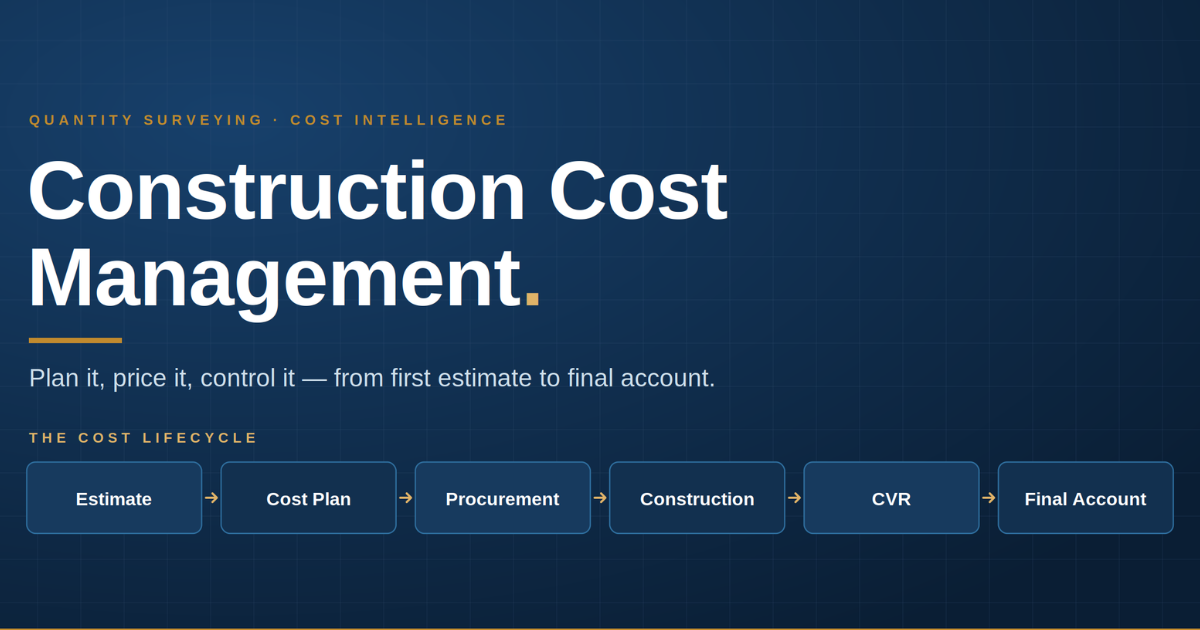
None of this is a one-off task, either. It runs the whole distance — from the first rough estimate to the final account you actually get paid on.
The Construction Cost Management Lifecycle
Every project follows the same rough arc, whether it’s a fit-out or a flagship scheme. Each stage hands something to the next, so a shaky estimate doesn’t just cause problems early — it poisons every decision downstream.
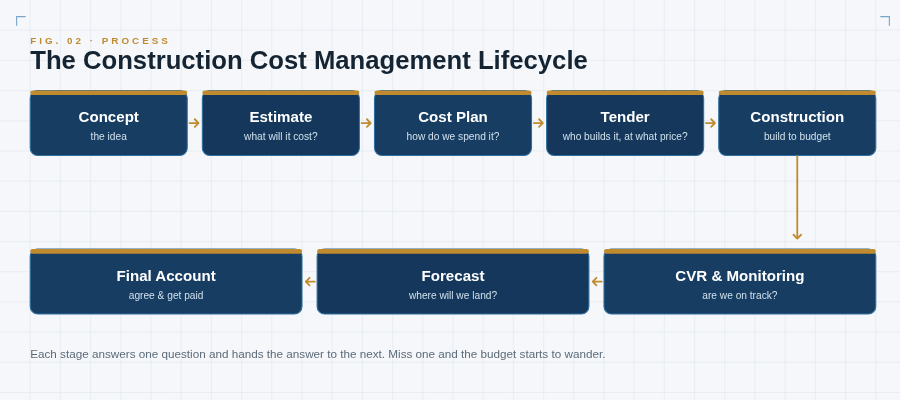
The value of seeing it laid out is that each stage is really just a question. The estimate asks what will this cost? The cost plan asks how do we spend it wisely? Monitoring asks are we still on track? And forecasting asks the one everyone dreads: where are we actually going to land? Leave any of those unanswered and the budget starts to wander.
Cost Planning vs Cost Management
People use these two terms as if they’re the same thing. They’re not, and knowing the difference genuinely sharpens how you work. One predicts; the other polices.
| Cost planning | Cost management |
|---|---|
| Happens before construction | Runs throughout the project |
| Sets the budget | Controls the budget |
| Lives in the design phase | Lives on site |
| Predicts likely costs | Tracks what’s actually spent |
| Shapes design decisions | Protects margin and cash flow |
construction cost planning gets the number right, and cost management keeps you honest against it. You need both. Skip the planning and you’re controlling a budget that was never realistic to begin with.
The 7 Proven Strategies
1. Improve Construction Estimating Accuracy
Everything downstream inherits the quality of your first number. If the estimate’s optimistic, you either lose the bid to someone sharper or — worse — win it and lose money building it. So this is where the rigour has to be highest.
Construction estimating is the practice of predicting what a project will cost before it starts. You measure the quantities, apply current rates, and build a picture accurate enough to price a tender or set a budget.
Here’s the trap that catches people: reusing last year’s rates. With tender inflation running at 3.5–5%, yesterday’s figures quietly turn today’s profit into a loss. Refresh them every time. Build from a proper Bill of Quantities, and don’t price scope you haven’t actually measured — those gaps come back as unpaid work at final account. Accurate construction cost estimating is the foundation of everything else, and it’s the heart of our Estimating & Tendering services.
2. Build a Detailed Cost Plan Early
The cheapest place to change a building is on paper. Move a wall in a drawing and it costs a little of a designer’s time; move it on site and it costs a fortune. Early cost planning is really just moving your decisions to where they’re cheap to change.
Say a developer’s choosing between two cladding systems. One’s cheaper to install, the other’s cheaper to run. A cost plan that looks past day one — at maintenance, replacement, the whole life of the thing — often reveals that the “cheap” option is the expensive building. That’s the sort of call you want to make early, while the design can still flex. It’s where good commercial management starts paying for itself.
3. Strengthen Your Procurement Strategy
Your procurement route shapes the final cost far more than most people expect. Pick the wrong one and you invite variations, delays, and arguments. Pick the right one and you hand each risk to whoever’s best placed to carry it.
Construction procurement management is how you choose and contract the right suppliers and builders. You settle on a route, run the tenders, and lock in clear terms — so price and risk are agreed up front, not fought over later.
The UK toolkit here is solid. NEC4 and JCT 2024 both give you tested ways to price work and share risk sensibly. And if you’re touching a higher-risk building, the Building Safety Act adds cost and approval steps you’ll want in the plan from day one, not discovered halfway through.
Picture a contractor pricing a £12 million office as steel prices bounce around. Bring the contractor in early under a two-stage tender, lock supplier rates before the market moves, and you’ve turned procurement into a genuine cost hedge. There’s more on how we approach this in Procurement support.
4. Manage Construction Risk Proactively
Risk is simply a cost you haven’t paid yet. Ignore it and it turns up late, usually on the worst possible day. A funded, thought-through allowance beats a round-number contingency pulled from thin air every single time.
Risk management in construction projects means spotting the things that could blow your cost or programme — and getting ahead of them. You log each risk, score it, give it an owner, and set aside money to match.
A simple matrix keeps everyone honest about what deserves attention:
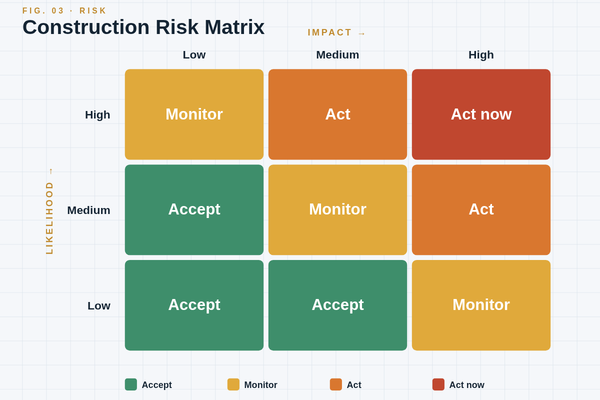
Revisit the register every month, and let it drive your contingency rather than the other way round. On bigger schemes, techniques like Monte Carlo simulation turn a nervous guess into a number you can actually defend to a client.
5. Monitor Costs With Monthly CVR
You can’t manage what you’re not measuring. Monthly cost value reconciliation turns cost tracking from a post-mortem into an early-warning system — and it’s often where a project quietly wins or loses its margin.
Cost value reconciliation (CVR) sets what you’ve spent against what you’ve earned. Do it monthly, element by element, and you can see which parts of a job are making money and which are losing it.
The timing is everything. Catch an underperforming package early and you can still do something about it. Catch it at final account and it isn’t a problem any more — it’s just a loss.
Pair CVR with earned value management and a solid cash-flow forecast and you’ll know not just where you are, but where you’re heading. That’s the whole point — see our CVR reporting.
6. Control Variations Before They Become Claims
Variations are where budgets bleed out slowly. A change gets made, nobody prices it properly, and six months later it’s a disputed claim and a chunk of work you did for free. A tidy change process protects both your margin and your relationship with the client.
The rule is simple: value a variation the moment it happens, not at the end. It keeps cash flowing, and it gives the client a clear, defensible story for why the number moved — which is worth more than people think when the final account lands. Get this right and it makes contract administration far less painful. (Our guide to handling contract variations goes deeper on the mechanics.)
7. Use Value Engineering to Cut Cost, Not Quality
Value engineering has a bad reputation it doesn’t deserve. It isn’t about cheapening a build — it’s about finding the same outcome for less money. Swap a specified finish for an equal-performance alternative and you’ve saved cost without anyone on site, or in the finished building, being able to tell.
Value engineering is the discipline of keeping the function while cutting the cost. You weigh design options against what they actually deliver, and pick the ones that give the client the same result for less.
Like most of this, it pays best early, while the design’s still soft enough to change. Done well, it’s the step that brings an over-budget scheme back within reach without a single compromise the client would notice.
Traditional vs Modern Cost Management
The discipline hasn’t changed in decades. The tools absolutely have. The old way looked backwards — spreadsheets telling you what went wrong last month. The modern way looks forward, flagging trouble while you can still steer around it.
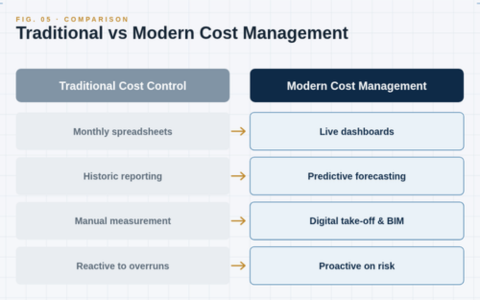
The best cost consultants haven’t thrown out the old skills, though. A good construction cost consultant blends the speed of digital project controls with the judgement that only comes from years of doing the job.
Whole-Life Costing: Budgeting for the Building’s Whole Life
Build cost is only half the story. For anyone holding an asset for the long haul — commercial landlords, public bodies — the cost of running and maintaining it over thirty years can dwarf what it cost to put up. Ignore that and every early decision gets skewed towards the wrong answer.
Whole-life costing counts the total cost of an asset across its life — not just the build. It folds in running, maintenance, and replacement costs, so you can compare options that look identical on opening day.
A roof that’s cheaper to lay but needs replacing twice as often isn’t cheaper — it just moves the cost down the line. Lifecycle costing brings that into the open while the design can still change. It’s one of the clearest ways good cost consultancy earns its fee.
Common Causes of Construction Cost Overruns
Overruns feel unpredictable in the moment, but they rarely are. Nearly all of them trace back to the same handful of culprits — and every one is manageable if you catch it early:
- Optimistic estimates — hopeful rates and scope that was never fully measured.
- Scope creep — a dozen small additions nobody stopped to price.
- Design changes — late tweaks that ripple through half the trades.
- Inflation — labor and materials climbing between tender and delivery.
- Weak procurement — the wrong route, or a supply chain that can’t cope.
- Labor shortages — a very real UK pressure right now, and a genuine cost driver.
Handle these up front and you’ve defused most of the risk long before it reaches the final account. That’s construction budgeting doing its actual job.
The Quantity Surveyor’s Role in Cost Management
If cost management is the spine, the quantity surveyor is the nervous system running through it. Someone has to hold the thread from the first estimate to the last payment — turning drawings into costs, and costs into control — and that’s the QS.
In practice that means preparing the estimates and cost plans, running procurement and tendering, administering the contract, producing the CVR, checking payment applications, valuing every variation, and finally agreeing the account. It’s the core of construction commercial management, and bringing that expertise in early rather than late is the simplest way to feel the difference in your bottom line. That’s exactly what our quantity surveying services are built around.
Frequently Asked Questions
Who is responsible for construction cost management?
The quantity surveyor usually owns it day to day, but it’s a shared effort. The client sets the budget, the design team shapes cost through their choices, and the contractor controls it on site.
What are the principles of construction cost management?
It comes down to a few things: estimate accurately, plan cost early, keep monitoring, share risk sensibly, and stay focused on value. And keep one person holding the thread the whole way through.
What are the main phases of construction cost management?
Estimating, then budgeting and cost planning, then procurement, then monitoring through CVR, and finally the account. Each one sets up the next.
What are the four types of cost in construction?
Direct, indirect, fixed, and variable. You need a handle on all four for a budget to hold up.
Why is construction cost management important?
Because it protects your margin, your cash flow, and your dates. With UK tender prices still rising, weak control quietly turns a thin margin into a loss.
Why do construction projects go over budget?
Usually some mix of shaky estimates, scope creep, design changes, inflation, and poor procurement. Almost all of it is preventable with early cost control.
What does a quantity surveyor do?
Estimates, plans, procures, and controls the money across a project — and values the variations and settles the final account along the way.
What’s the difference between cost control and cost management?
Cost control is the day-to-day tracking of spend against budget. Cost management is the wider process that control sits inside.
What is CVR?
Cost value reconciliation — spend set against earnings, checked monthly, so you can see which parts of a job are winning and which are losing.
How often should I review construction costs?
Monthly at the very least, through CVR. On riskier jobs, more often than that.
Key Takeaways
If you take nothing else away: get the estimate right, plan the cost early, and use procurement to control risk rather than just paper over it. Then price your risks properly, watch the job with monthly CVR, keep a firm grip on variations, and value-engineer while you still can. That’s what construction cost management really is — seven habits that, done consistently, keep projects on budget and margin in your pocket.
Related reading: Estimating & Tendering · CVR · Contract Variations · Dispute Resolution · Quantity Surveying Services
Talk to Us Before the Budget Gets Away From You
Whether you’re pricing your first tender or steering a live project, Quentessential Surveying can help you improve cost certainty from pre-construction all the way through to final account. We handle estimating, procurement, CVR reporting, and full commercial management for UK projects — commercial, residential, infrastructure, and renewable energy.
Book a consultation · Call the team · Email us